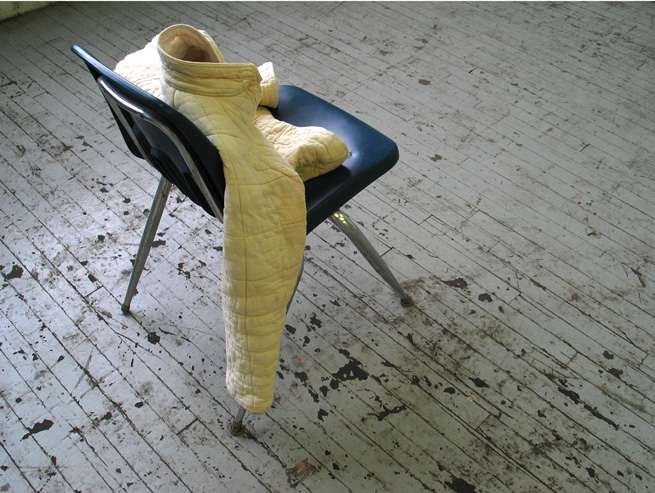
In American Framing and Ground, absence is again nebulously embodied and finely probed through a distinct, if ambiguous, male protagonist. Alternately seen from behind (like the items in Jacket), surveying saturated nightscapes of off-hours industrial lots and holiday light-strewn yards, or laying prostrate on the ground, a German newspaper opened flat across his chest, and vague articulations of a city park at night surrounding him, he appears at once contemplative and confrontational. His solitary, broad-shouldered stance, filled-out by the hard lines of a leather jacket, observes a world that seems removed and alien. As he lies, face obscured, in the thin grass of the park, a kind of soft slain is suggested -- at another's hands or by the burden of strange news. While the narrative is spare, a kind of cinematic intrigue pervades these images; what menaces the solitary figure at night could be as much his inaccessible thoughts or an off-scene drama -- all of it just as possibly the stuff of memory or dreams.
These formally evocative and expert works ultimately convey a project that is more rooted in the poetically associative mind than plainly evident perception. Through the undulating, chromatic rhythms of coats postured repeatedly in empty repose to the formidable presence of a body at night, considering the strangeness of articulated space, a world not entirely evident is betrayed -- suggesting that perception is indeed the last clue to heed.
"American Framing" Jessica Baran
contd page 2 of 3
Jessika Miekeley
St Louis, MO
Missouri
North America