
|
Hala ElKoussy Page 1 | Biography |
|||||||||
|
|||||||||
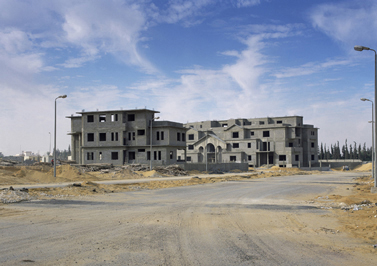
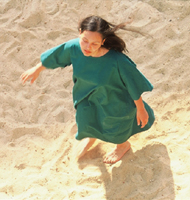
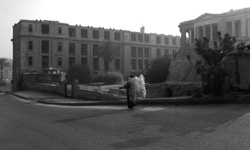
peripheral stories, 2005, production still
|
Introduced as a series of stories, the allusions to narrative coming in and out of focus throughout the film create a framework for seducing the viewer into a suspension of both disbelief and belief. There is little to guide the viewer through the piece. Time is a function of a repetitive movement and the cyclical re-appearance of characters and references, if only for a moment and out of the corner of the eye.
|
|
|||||||
|
The series of still photographs that constitutes the film’s own periphery offers a different kind of space of engagement for the viewer. Emotionally charged, large-scale landscape photographs appear alongside the film. They provide a static representation of the psychological space connected to the socio-economic and geographic periphery depicted in the film. Printed on wallpaper material, the pieces suggest both the lurid plastic Swiss alpine scenes that are to be found in homes, restaurants and cafes and which appear twice in the film itself, as well as fine art traditions of landscape painting and photography. Dwarfing the viewer while failing to create a complete environment, these pieces are more tributes to a romantic ideal of place than convincing representations of the real. |
|||||||||
|
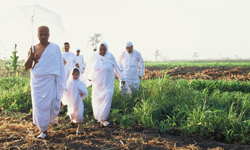
Candyfloss Stories opens with an old errant seller calling out to the lady of miracles to come to his rescue, to see what has become of the people and the city. This film is based on interviews with Cairenes about their aspirations and frustrations mixed with news bits collected over the Internet. In cyclical fashion, the characters turn roofs into sets in which they are on “top of the world”: rooftops being non-places that hover between the public and the private.
|
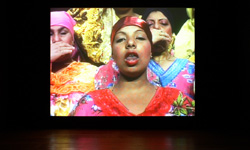
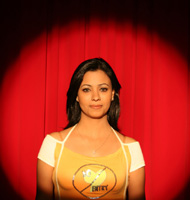
the interviews, digital video, 2005
|
In The Interviews, 6 extras are placed under the spotlight and asked to answer the same set of questions. The questions address their position in society, their relationship to Cairo, their values and their dreams. The artificiality of the setting stands in sharp contrast to the spontaneity of the delivery and questions the documentary nature of such a product. The fact that the interviewees are actors whose livelihood rests on assuming different personas further complicates the process.
Ultimately, the viewer is implicated in assuming the role of the absent interviewer and of the spotlit interviewee. |
|||||||
|
|||||||||
International contemporary art
SIGN UP FOR NEWSLETTERS
 SERVICE OVERVIEW
SIGN UP for ARTIST MEMBERSHIP
SIGN UP for GALLERY MEMBERSHIP
NEWSLETTERS & ANNOUNCEMENTS
NEWSLETTER SCHEDULE
ARTIST OPPORTUNITIES
POST ARTIST OPPORTUNITY
SERVICE OVERVIEW
SIGN UP for ARTIST MEMBERSHIP
SIGN UP for GALLERY MEMBERSHIP
NEWSLETTERS & ANNOUNCEMENTS
NEWSLETTER SCHEDULE
ARTIST OPPORTUNITIES
POST ARTIST OPPORTUNITY
Click on the map to search the directory