
|
Gina Ruggeri Page 1 |
|||||||||
|
|||||||||
2.
|
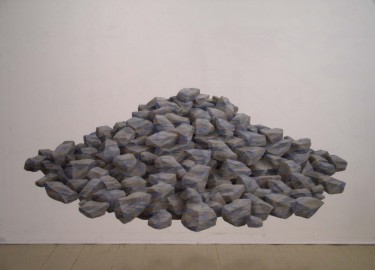
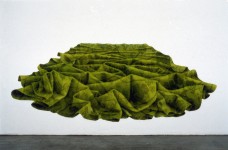
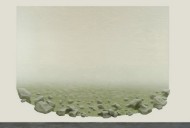
In this aspect, the works have a relationship with the varied traditions of fresco painting, stage design, and Minimalist sculpture. Because it is removed from the traditional frame of the rectangle, the image often appears as an illusionary object that floats in the white space of the wall, hovering in a continuum of physical and pictorial space.
|
|
|||||||
|
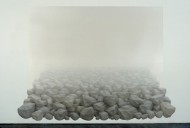
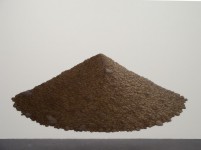
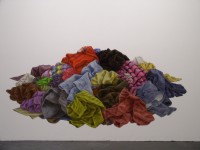
The imagery often has a dreamlike quality, in that it feels at once ‘real’ and imagined. Landscape and human references entwine, implied in such images as a pile of rocks, or implicit in a stage set-like landscape of stones. The paintings are illusionistic yet stylized, often with decorative patterns running through the images that complicate the realism. The flatness of the patterns both defines and contradicts the forms, creating a paradoxical visual tension that resonates with the imagery. The images are represented at life size, and, depending on the subject, are hung either low or high on the wall. This placement creates a spatial dynamic that underscores the relationship of scale with the viewer. The volumetric rendering and one-to-one scale of the images make them feel almost sculptural, as though, not content to be a ‘picture of‘, they are attempting to ‘become’ what they represent.
|
|||||||||
3.
|
IMAGE DESCRIPTION : 1. – Rockpile; oil on Mylar; 42 x 93 in.; 2003. 2. – Stones; oil on Mylar; 82 x 113 in.; 2003. 3. – Greenfolds; oil on Mylar; 48 x 110 in.; 2002. 4. – Dirt Mound; oil on Mylar; 42 x 97 in.; 2004. 5. – Clothes Heap; oil on Mylar; 42 x 99 in.; 2004. 6. – Stones in Water; 78 x 108 in.; 2003.
|
||||||||
|
|||||||||
International contemporary art
SIGN UP FOR NEWSLETTERS
 SERVICE OVERVIEW
SIGN UP for ARTIST MEMBERSHIP
SIGN UP for GALLERY MEMBERSHIP
NEWSLETTERS & ANNOUNCEMENTS
NEWSLETTER SCHEDULE
ARTIST OPPORTUNITIES
POST ARTIST OPPORTUNITY
SERVICE OVERVIEW
SIGN UP for ARTIST MEMBERSHIP
SIGN UP for GALLERY MEMBERSHIP
NEWSLETTERS & ANNOUNCEMENTS
NEWSLETTER SCHEDULE
ARTIST OPPORTUNITIES
POST ARTIST OPPORTUNITY
Click on the map to search the directory