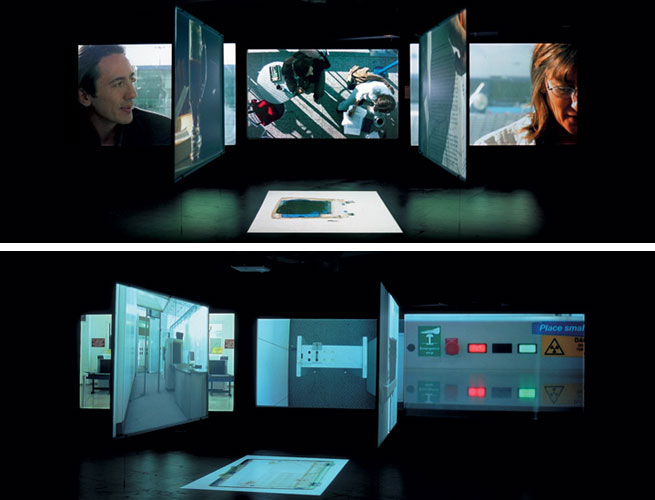
Ergin Cavusoglu, Point of Departure, six channel video installation, three channel sound, Northern Gallery of Contemporary Art, Sunderland, 2006. Image � Ergin Cavusoglu
The first thing you hear is the clatter of a train. Even before you enter the Kunstverein Freiburg�s large, darkened exhibition space housing the Bulgarian-born Turkish artist Ergin �avusoglu�s solo exhibition �Place after Place�, you are confronted by a the soundtrack of Midnight Express (2008), which sounds like it�s from another era. From speakers at the entrance of the exhibition, railway carriages can be heard rumbling over a switch � an anachronistic noise in the age of high-speed train travel. The show�s central work, on the other hand, the video installation Point of Departure (2006), thrusts the exhibition into the modern age. Composed of six synchronized projections arranged to form two rectangles with three audio channels, the work re-creates an airport environment: the tedious security controls, the interminable waiting, the fleeting contacts. �avus�og�lu�s images are not taken from large international air traffic hubs, however; rather, the artist filmed at London�s suburban Stansted Airport and at the airport in Trabzon, a city on the Turkish coast of the Black Sea. Both locations are destinations for budget flights, and �avusoglu�s work emphasizes this. One long tracking shot shows a row of aircraft all bearing the logo of budget carrier Ryanair. In the image of these grounded aircraft, Point of Departure could foreshadow a future in which rising oil prices would force budget flights to be discontinued, and such sights will seem part of a bygone era. The contradictions, losses and latent tensions of globalization and migration are the thematic current of �avusoglu�s work. Point of Departure calls attention to the sometimes-irrational procedures that dictate our movements in airport terminals � even though these exchanges are organized according to specific rules. Airports employ cutting-edge technology, yet the use of X-ray scanning machines is motivated largely by a relatively uncontrollable psychology: fear. �avusoglu lets this ambivalent correlation be felt in his work. The artist films bulky bags and crammed plastic sacks tumbling out of the baggage system while a crush of older Turkish women dressed in muted-coloured robes grab for their belongings, accompanied by a threatening thumping sound, like a rapid heartbeat. But the suspense leads nowhere. No one is exposed; there is no arrest; no bomb suddenly explodes. Instead, the artist visualizes subtler tensions: the Turkish women in their inconspicuous dress stand in stark contrast to the casual demeanour of a computer-toting man (played by the artist himself) from the mobile Western middle class who ambles through the goings-on. He makes a conspicuous counterpoint to the women�s crutches, canes and humble baggage. Two types of culture clearly meet here, but �avusoglu does not pit one against the other. The laptop-wielding man is not presented as the hero of a new age, nor are the physically less able women deemed part of a dying breed. Instead, what becomes apparent in �avusoglu�s work is how unconstrained they seem � as if the security apparatus and controls don�t bother them at all. Identifying instances in which seeming anachronisms coexist in modern spaces is a recurring theme in �avusoglu�s work. Globalization has been accompanied by an intense acceleration of existence that is inescapable. Air travel, for instance, allows people to leave their homelands to find better living conditions, but their new surroundings do not necessarily quench the need for cultural and social belonging. �avusoglu repeatedly brings these kinds of losses back into view, but he also shows how resistant and persistent some habits and traditions are. In his video installation Silent Glide (2008), two lovers are captured in the midst of a quarrel. When the male protagonist quotes from Leo Tolstoy�s memoirs, or when his partner assumes the attitude of a spoiled young aristocrat, it seems that this scene could just as easily have taken place 100 years ago. The dispute plays out against the backdrop of the shipping channels across the Sea of Marmara, while a bleak vista of the cement factory in the Turkish city of Hereke can be viewed through the window of the room in which the couple is arguing. The dust-grey construction site offers no hint that sumptuous silk carpets have been knotted in this city for centuries. �avus�og�lu successfully sustains a sense that something here is not right, something far graver than a relationship crisis. The fragile, white model ship that the artist repeatedly introduces into the frame becomes a symbol of this troubled feeling, triggering associations with the ghost ship Flying Dutchman and other tales of disaster on the high seas. Such notions could suggest something poetic, even romantic, yet �avusoglu keeps a vision of harsh contemporary reality firmly in focus throughout. Frequently, his aesthetic precision lends �avusoglu�s work an air of inconspicuous normality. Yet behind every image, every scene, nothing is certain, everything is in motion; nothing is more than a fragile construction.
Translated by Rosanne Altstatt Michael H�bl Frieze (October 2008)
�Ergin Cavusoglu: Point of Departure�
It is a clich� of current times that �we are all members of diaspora now�. Whether that stands close scrutiny is debatable. However, as the skies are criss-crossed with aircraft carrying business people, pleasure seekers and refugees, it is clear that something has changed, even from half a generation ago. In the Global Village we are all permanently on the move, and we are all familiar with the stress and tedium of airports. The eponymous �Point of Departure� comprises five projections on translucent screens, with a sixth projected onto the floor. The screens, wich feature scenes from two airports, create an architectural space through which the viewer can pass. Characters meet at Stansted and Trabzon in Turkey: airports at the Atlantic and Asian fringes of Europe. There is a hint of narrative, but nothing conclusive. The familiar experience of X-ray baggage checks, metal detectors and PA announcements is played out. The sleek steel and glass architecture of Stansted is visibly different from the cream and grey municipal style of Trabzon, but the experience is essentially the same. Adrift is the second major piece in the show. Four screens change continually: city streets, grand buildings, people walking, tube trains departing; in the background the city�s noise is coupled with portentous-sounding music. Kids swing on a scaffold. The moon appears in the night sky and then vanishes. Tourists in a museum study an architect�s model. A jet flies (now ominously) over the New York skyline. A yacht floats serenely by in a seascape. Equivalence to the real experience of contemporary spaces is created. One becomes aware of the partial understanding one has of a complex space, in which information is gathered and filtered because there is too much to take in. This also draws attention to our relationships with art and screens: an expectation of conventional narrative is created, but the sequences refuse to offer this. The egalitarian qualities of the screens override the natural mental filters through which we attend to some things and eliminate others, and each of the scenes with its potential for meaning or meaningless demands equal attention.
Stephen Riley, AN Magazine (July 2006) Ergin Cavusoglu Sunderland