The dialogue between object and image is at the heart of Mitten�s practice. Quickly-made painterly objects, (constructed from packaging, paper and other stationery), function as three-dimensional sketches for drawing, painting and collage, whereby the original is transformed through flattening, editing and error. When flipped back to 3d, the reconfigured construction is a strange hybrid � both a condensed synthesis of these multiple processes of looking and understanding, but also something suggestive of other disparate references.
The Aztech series, developed for The Lobby, One Canada Square, takes as its starting point the architecture and context of the exhibition space. Described by the curator Ann Elliot, as
�a mock world of technological innovation�, Mitten�s � obsolete technological kit� includes high�tech gadgets of contemporary city-life (laptops, mobile phones, touch-screens and handhelds, chip and pin machine, clocks and watches), all perversely cut and pasted from old cardboard files.
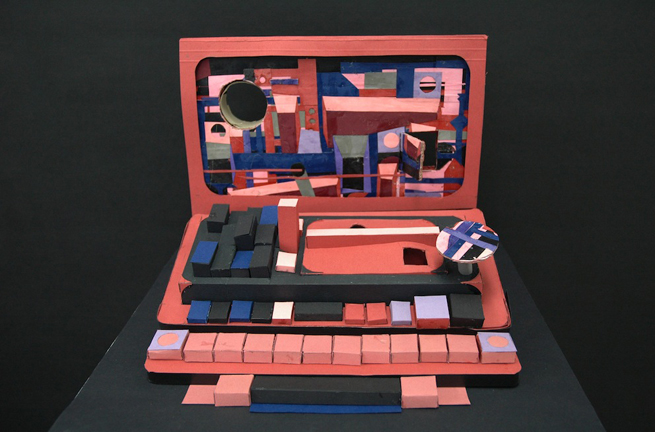
In keeping with the artist�s more scattered installation-based works, Aztech_Toppal is made up of multiple, unfixed component parts. Unlike the laptop it suggests, this model is robbed of its portable convenience and requires assembly before use, and its name is a play on the precarious piling of pieces which invariably find themselves askew and in the wrong order.
Reminiscent of shape-sorters and building blocks, Mitten�s palette is comprised of flat and 3d shapes as much as it is one taken from the fixed colours of filing systems, selected to tune into the architectural colour-scheme it will inhabit.
In an analogy to painting, it is as if the laptop has been closed (or has collapsed and folded) while the board was still wet, and on re-opening, has left a butterfly print � in part reflecting elements of the 3d keyboard, while much of the visual data has been scrambled in translation, and is suggestive of a patterned construction site, circuitry, brutalist and de Stijl design.
Buttons are fetishised, popping up and out at every opportunity; colour is heightened, as if the saturation slider has veered too far to the right; and the surface of the screen is incised with portals and windows to the space beyond, while seeming to nod an ironic wink to the viewer.
�The Big Picture�, a-n Magazine, September 2010
|

 SIGN UP for ARTIST MEMBERSHIP
SIGN UP for GALLERY MEMBERSHIP
SIGN UP for ARTIST MEMBERSHIP
SIGN UP for GALLERY MEMBERSHIP