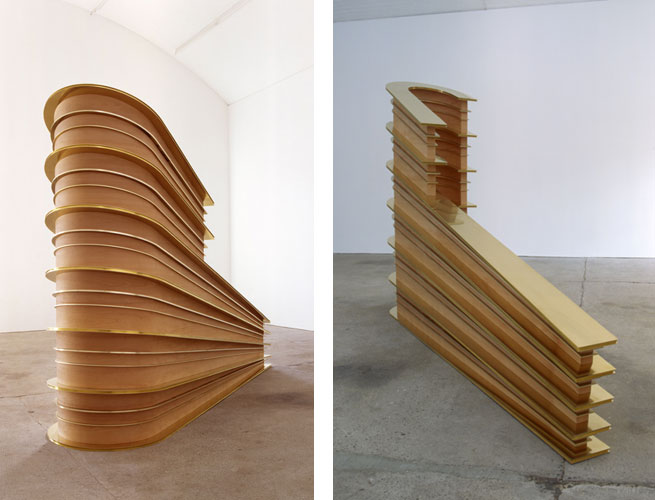
In his sculptures, collages and films, Bojan Sarcevic explores the �ghost haunting modernity�: ornament and decoration
Issue 117 September 2008, frieze magazine By Jennifer Allen
Moving Pictures Sarcevic�s most recent solo exhibition at the Hamburger Kunsthalle features his series of films �Only After Dark� (2007), in which the artist has basically made moving pictures out of still sculptural forms: paper, stones, a slab of steak, a tree branch. �I see these pieces as actors�, says Sarcevic, who wanted to create the possibility of an almost social rapport between them. Of course, sculptures are not action figures, let alone actors with speaking parts; the movement comes only through the camera � changing frames, new perspectives, zooms in and out � as well as through the instrumental music score, which seems inspired by the more meditative manifestations of experimental jazz from the 1970s. While reducing the sculptures from three dimensions to two, the films lend them an illuminated texture as well as the depth of projected images. �But the films are not stories about these objects�, says Sarcevic. While forcing viewers to perceive the sculptures through the perspective of his camera lens, the artist gives viewers another sculptural experience by building a custom-made screening-projection room for each film. Each one gets a kind of mobile home for its travels, though Sarcevic calls them �pavilions�. In contrast to most projections � including his own early ones � �Only After Dark� comprises both films and mini-cinemas. Everything � the walls and the ceilings, the churning reels of the projector and the moving images glowing on the wall � becomes a surface.
Of course, the final destination for all of these migrations is the public museum and the private collection, where every decorative and ornamental element, whether triangles or tree branches, will be appreciated as an art work. Their fate raises yet another spectre haunting contemporary art from the historical avant-garde to the present day. There�s a key sentence in Loos� condemnation of ornament in his discussion of tattoos: �The urge to ornament one�s face, and everything in one�s reach, is the origin of fine art.�6 Many artists who sided with Loos would prefer to forget that he essentially wanted to free architecture and the applied arts from the fine arts; they wanted to free the fine arts from criminal ornament too. As Br�derlin notes, already in 1907 Paul Klee worried about distinguishing his work from ornament; by 1917 Hugo Ball sarcastically wondered whether abstract art would produce anything more than �a revival of ornament�; today calling an art work �decorative� or �ornamental� still constitutes an insult. Yet ever since Immanuel Kant put the fine arts and ornament together, they have shared the key criteria for aesthetic judgements: beauty and uselessness. Beauty may have since waned, but uselessness has not, despite the interactive drive of relational aesthetics and the spate of crossovers. Indeed, what is a ready-made, if not a useful everyday object taken out of commission: for example, a urinal that can�t be used since it�s only for decoration? Sarcevic not only embraces the ornament as a fully legitimate art but also shows that both ornament and decoration are vital social manifestations, which hold complex and often nomadic histories that link different cultures and time periods. By embracing ornament, Sarcevic has taken a very different path from many of his contemporaries, who have instead chosen to question the neutrality of Loos� architectural Modernism, including Minimalism. Of course, that�s another obstruction.
1 W.G. Sebald, Luftkrieg und Literatur (On the Natural History of Destruction), Carl Hanser Verlag, Munich and Vienna, 1999 2 I take the quote, and many of my subsequent arguments, from Markus Br�derlin�s excellent �Introduction� to Ornament and Abstraction: The Dialogue between Non-Western, Modern and Contemporary Art, ed. Markus Br�derlin, Fondation Beyeler, Riehen/Basel, and DuMont B�cherverlag, Cologne, 2001, p. 20 The exhibition took place at the Fondation Beyeler, 10 June�7 October 2001 3 My subsequent definition of the square kufic pattern comes from James Trilling, The Language of Ornament, Thames & Hudson, London, 2001, pp. 126�7 4 Br�derlin, op. cit. 5 Adolf Loos, �Ornament and Crime� (1908), in Crime and Ornament: The Arts and Popular Culture in the Shadow of Loos, ed. Bernie Miller and Melony Ward, YYZ Books, Toronto, 2002, pp. 29�36. See also Das Sch�ne am N�tzlichen: Ornament und Architektur (The Beautiful in the Useful: Ornament and Architecture), ed. Moritz Wullen with Bernd Evers, Kunstbibliothek, Staatliche Museen zu Berlin � Stiftung Preu�ischer Kulturbesitz, Berlin, 2007. The exhibition took place at the Kunstbibliothek, 28 September�25 November 2007 6 Ibid., p. 29
Jennifer Allen Jennifer Allen is a critic living in Berlin.