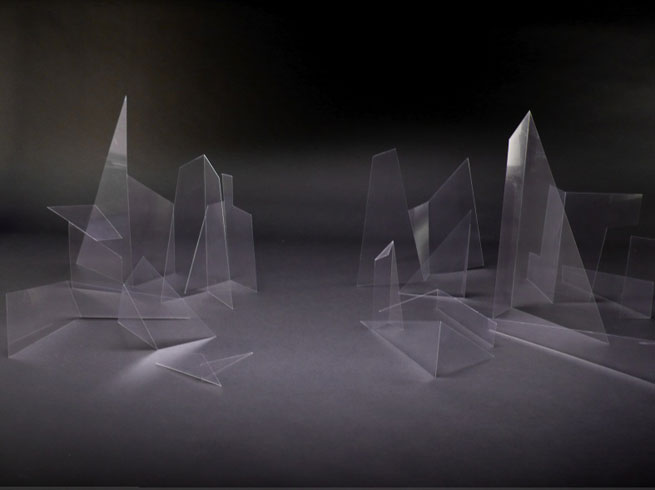
Bojan Sarcevic, Installation view, Kunstverein in Hamburg, 2008 Only After Dark Series, untitled (film 2), 2007. 16mm film, 2.47 min. color/sound, Camera: Sandra Merseburger. Music: Carlo Peters Image � Bojan Sarcevic
In his sculptures, collages and films, Bojan Sarcevic explores the �ghost haunting modernity�: ornament and decoration
Issue 117 September 2008, frieze magazine By Jennifer Allen
While creating surface patterns, Sarcevic is also happy to find them. Consider Working Surfaces (2004), a found object consisting of two black granite slabs that the artist purchased from a mine near the Mediterranean resort town of Cap d�Agde. Covered with a maze of lines and circles, the slabs are the miners� variation of the butcher�s block � used over the years for cutting other pieces of granite destined for construction. When Sarcevic moves beyond the found surface to create a fully autonomous structure, he tends to evoke architecture without ever building it. Replace the Irreplaceable (2006) � a three-dimensional �J� form made with solid layers of pearwood and brass that fan out like a massive pair of bellows � reverses the traditional hierarchy, in which architecture is the fundamental foundation and ornament is an added afterthought. The hook of the �J� is wide and tall enough to accommodate an adult, yet the piece is so finely crafted that any architectural use appears secondary, if not superfluous. Why bother adding a roof and more walls to make a shelter? Other works combine created and found patterns. �Untitled� (2006) � a series of sculptures made from delicate bars of brass joined together � is adorned with geometrically patterned silk scarves that the artist picked up at a Berlin flea market. In photographs the bars look like the lines of so many connected thoroughfares extracted from a city map; the scarves, folded around the bars, demonstrate that these works are actually three-dimensional forms, both protruding from the wall and using the wall as a floor support.
At the Corner of Ornament and Architecture With such interventions Sarcevic is charting an obstruction of memory that goes beyond post-WWII Germany, former Yugoslavia, the intersection of Islam and Christianity or the forgotten labour of Europe. Ornament is the ghost haunting modernity and its many expressions � whether architecture, industrial design or painting. In his catalogue essay for the exhibition �Ornament and Abstraction� (2001) at Fondation Beyeler, curator Markus Br�derlin calls ornament �the secret stowaway� that went into hiding in abstract paintings from Piet Mondrian to John Armleder.4 Ornament has been on the run ever since being condemned in Adolf Loos� diatribe �Ornament and Crime� (1909), which accused it of being �degenerate� on several counts, economical to ethical. Loos pithily remarked: �The evolution of culture is synonymous with the removal of ornament from objects of daily use.�5 Riegl, with his definition of ornament as �a pattern on the surface�, unwittingly supported what would become a widespread eradication; once defined as a redundant surface, ornament could be simply smoothed away, like a layer of old paint, without changing the underlying form, let alone its function.
Like Br�derlin, Sarcevic acknowledges the deep historical bond between abstraction and ornamentation, although many of his works, such as �1954� and Miniatures, manifest this bond by unsettling figurative elements (the view into the interior and out of the car). �Ornament and Abstraction� recognizes abstraction�s debt to Islamic art and its ban on figuration. Br�derlin begins by tracing the migration of ornament from architecture and design into abstract and non-figurative painting around the time of Loos� diatribe � the curator identifies a both geometric strain (Rodchenko, Mondrian, Albers) and an organic one (Kandinsky, Matisse, Pollock) � and ends up finding the stowaway in everything from painting and sculpture to tapestries and computer graphics. Sarcevic follows another closely related trajectory: to show that architecture never got rid of ornament, that function and form never freed themselves of decoration.
Already in his graduate show in 1997 at the �cole nationale sup�rieure des beaux-arts in Paris, Sarcevic took bits of useful writing paper and rolled them into little balls to adorn a crack in a free wooden support beam traversing his atelier; stopping a draft did not seem to be the order of the day. Sarcevic�s work on corners best demonstrates how the criminal and the innocent elements are always bumping into each other, belonging and not belonging, mixing different times, fates and stories that have never been allowed to exist together. The stowaway is always showing up. For his d�but in Berlin in 1999, the group show �Soft Resistance� at carlier|gebauer, Sarcevic extracted the lower corner of a room in a condemned Amsterdam house, as though it were a frieze on the ceiling, and reinstalled it in the gallery. Far from a salvaged Dutch antique, Coin du monde (Corner of the World, 1999) was a banal corner, albeit with a historical itinerary, linking the two cities and their contested urban renewals. With this project Sarcevic revealed that corners, however useful they appear, don�t really hold up a room, because if you remove or replace one of them, the walls don�t fall down. One of the most basic elements of architecture might be as redundant as a delinquent caryatid or a felon frieze.
Since then the artist has worked with the corner as a meeting place not just for two walls, a ceiling and a floor. Fitted into the upper corner, Spirit of Versatility (2002) is a maze of muqarna, the honeycomb-like niches that are traditionally used for corbels and vaulting in mosques. Placed on the floor, Spirit of Inclusiveness (2002) is a one-to-one replica of one corner of the Cologne Cathedral with its curved Gothic panels in brass, copper, steel and zinc. Both of these corners, while indented, protrude outwards; since nothing lies behind them, both act as decorative fa�ades that round out the squared edges of the rooms where they are exhibited. They are corners for making circles out of squares. Where the Hand Doesn�t Enter, Heat Infuses (2003) creates an intersection with a free-standing wall and a glass sphere within an existing corner of the exhibition space; it�s not clear where the architectural support ends and the decorative begins. Using both rounded and squared corners, Sarcevic has also made a series of upright ornamental structures that evoke walls without actually being solid. Their poetic titles � Everything Makes Sense in the Reverse (2005), Wanting without Needing, Loving without Leaning (2005), Keep Illusion for the End (2005) � match their elaborately crafted appearance but stand in contrast to their simple materials: steel, brass, copper, oak, concrete.