
|
Bart Domburg Page 1 |
||||
|
||||
|
VOUS ETES ICI presents Bart Domburg: ohne Titel -8 Jan to 6 Feb 2005. In the period 1998 until 2003 the work of Domburg mainly revolved around the landscape (influenced by people) in all its facets. For instance the seas, the Jewish cemetery in Berlin, (the view from) the inner square of a concentration camp, a group of trees in a park in Zwolle (NL) or the garden of Gethsemane. |
||||
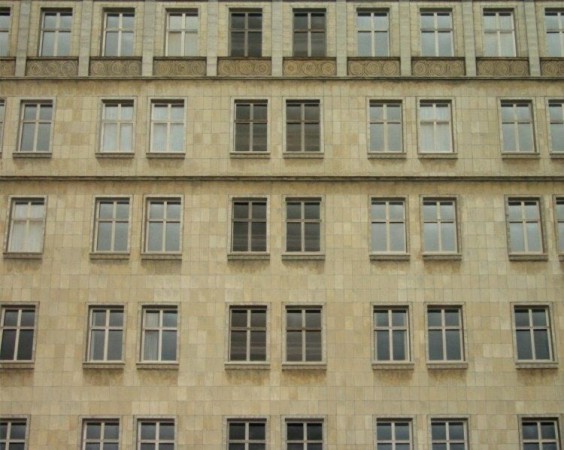
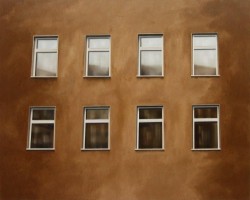
The rather dry, but at the same time rich way of painting, which Domburg developed in recent years, seems to be completely sufficient to deal with his at first sight innocent subject matter. Although the brushstroke is clearly detectable, his images appear to be photographic. It isn’t surprising that Domburg uses his own photo material as starting point for his paintings. Unlike many of his colleagues, who use projection, Domburg transfers the image of the photo by drawing a grid over it to enlarge it onto the canvas. This makes for an interesting interaction between both the painterly and pictorial aspects of the works. Towards the end of 2003 Bart Domburg (NL-Zwolle, 1957) started painting a facade with windows for the first time. In his second solo exhibition at VOUS ETES ICI Bart Domburg shows four big new paintings with this theme. In all four works the view of a facade is seen from street level, which makes the perspective shift, resulting in a dynamic perception of the windows. Our eyes feel the urge to correct this tilting. |
The windows themselves are half transparent, half reflecting. We only get a glimpse of the inner spaces behind them, as the reflection of the sky doesn’t permit more transparency. There is no sign of any human presence, although the plain curtains or burning neon lights remind us of their activity.
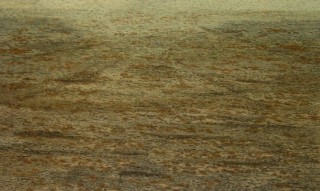
All windows are set in sombre, not to say smudgy walls. Domburg painted them, based on the reality of the mostly grey areas in East-Berlin (where he has been working the last couple of years) and East-Germany. One of the paintings features a bright, grand scale building, clearly of a communist signature, but now obviously cleaned and restored. But just like in the other paintings the reflected sky is closed of by clouds. To complete the exhibition a painting from the year 2003, called Appelplatz is shown. This cinemascope-sized work represents a close up of the pebbled courtyard of a former concentration camp. Here as well, perspective plays a major role, specifically because there is no horizon, although one can detect a vanishing point.
|
|||
|
||||
International contemporary art
SIGN UP FOR NEWSLETTERS
 SERVICE OVERVIEW
SIGN UP for ARTIST MEMBERSHIP
SIGN UP for GALLERY MEMBERSHIP
NEWSLETTERS & ANNOUNCEMENTS
NEWSLETTER SCHEDULE
ARTIST OPPORTUNITIES
POST ARTIST OPPORTUNITY
SERVICE OVERVIEW
SIGN UP for ARTIST MEMBERSHIP
SIGN UP for GALLERY MEMBERSHIP
NEWSLETTERS & ANNOUNCEMENTS
NEWSLETTER SCHEDULE
ARTIST OPPORTUNITIES
POST ARTIST OPPORTUNITY
Click on the map to search the directory