A Found Constructivist World
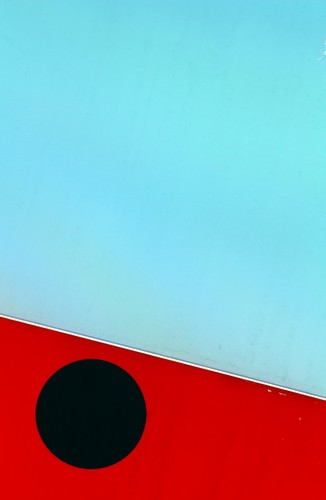
Reality and abstraction: the simultaneous presence of these two quite contrary notions characterises most the well-ordered world of Anikó Robitz’s photography. From the outset, she was interested in forms, found geometric structures in the environment, free of complicated theoretical concepts. She builds with austere geometrical forms, but the role of construction is overtaken by the mapping of real locations, and through these, the visual abstraction of the world around us is made visible. At first, she photographed at construction sites, with partially built edifices serving as her subject matter. Their surfaces inspired her first images, in which she discovered patterns formed by cracks, fissures and plasterwork. This was later supplemented by numerous elements: here and there, gesture-like, cutting into the image, a cable or shadow, the profile of a building or its silhouette entered the image, cleaving through the composition vertically, horizontally or diagonally. The vocabulary of architecture, however, is merely the paraphernalia, whose lines and rasters aid in directing the viewer’s attention to the geometric forms of the built world. There is no retouching in Anikó Robitz’s pictures: their composition is born in the camera, by selection, and she does not change them after shooting them. Alongside the austerity, the unusual perspectives, framing and irregular surfaces also lend a playfulness to the geometric visual constructions. Robitz seeks locations and surfaces where these constructive compositions are already present in their own “natural condition”. The framing places them in a new context, lifting them out of their original milieu, by which they lose their original function, and, abstracted from their visible form, instead of a subordinated relation, they are rendered an autonomous form of expression. Her works of a minimalist world of forms are constructed from few motifs; at the same time, their means of construction is democratic: each element receives the same emphasis. They draw their inspiration from building details, the majority of which are works of modern and contemporary architecture. Anikó Robitz’s photos are not really about architecture: this only serves as a point of departure. She finds her compositions in details that are generally not intended as artistic expression, but rather have a function or task of articulation. She places the emphasis on the details rather than the whole, and her pictures are born by recording the view focusing on these. The reductive palette, however, is not a product of editing work after exposure: she photographs compositions that are black and white in reality. This aids in attaining a distance from the present, and placing the world she depicts into a kind of timeless context. In her own words, she finds that colour rather distracts attention, though at the same time, in her latest series, colour does emerge – if with a muted intensity. The subject of many of her compositions is the wall itself and the projected shadows appearing on it, which break the monotonous surfaces or double the motifs in various rhythms. While larger and smaller elements break up the closed composition, the “irregular” details emphasise the definite surfaces dominating the picture plane even more, as if they were structural elements. Anikó Robitz’s pictures are born with the discovery of the constructive combination of lights, materials and forms. This is a reductive universe, where infinite order is present simultaneously with the desire to escape from it. Robitz’s vision is akin to the objectives of Suprematism, according to which the image should not approximate anything at all, nor depict, nor express emotions, nor describe events, nor be decorative – it should be just like architecture: identical with itself. Space and the light compel us to discern the objects. Often it is the materiality that dominates the image, appearing within the monochrome surfaces, revealed especially by the edges cropping up at the corners of the walls. The surfaces are present in their own naturalness, while the small, subtle aberrations of the mortar emerging on the regular surfaces in that materiality, or by way of shadows, bring a measure of irregularity into the frame. The urban space appearing in the images emerges in the elements of the modern metropolis that is at once crowded and dynamic: but it is always the calm, reduced details that we see. It is a world that is chaotic as a whole, but in its details it is ordered with almost mathematical precision, regular and transparent: a miniaturised copy of urban structure realised with human collaboration – an abstract composition, as a whole. It is a departure from quotidian time and space. These architectural spaces and volumes diverge from the classical tradition of architectural photography, and though they are “constructed” from the typical elements of the urban space, they rather evoke the visual realm of Constructivist compositions. It is always concrete locations that appear, but in the intentionally unidentifiable details of cities: alongside Berlin, Barcelona, Tirana, Paris, and Graz, also fragments taken from the Budapest urban districts of Angyalföld and Józsefváros. The buildings, nevertheless, remain incognito throughout, with only the picture titles revealing their geographical locations. While architecture calls for exemplification of one of the masteries of the constructed world, the two-dimensional spatial constructions that appear in the images represent an imprint of reality. We can consider contemporary architecture as either subject matter, or as a compositional element, and not as a new type of phenomenon in the history of works of fine or photographic art. Lucien Hervé, László Moholy-Nagy and the intellectual heritage of the Bauhaus are undeniable in view of Anikó Robitz’s photographs, but at the same time, their influence is perceptible rather as a method of seeing than as concrete prototypes. Alongside the cityscapes, in her new works, rather than the working method of selection, she herself creates and arranges the compositions. Her One-Hour Photo, and later, the Grid series, were born from her experimentation related to depth and darkness. “Although at first I wanted to make black pictures, the second element was white, nevertheless. The title of the series originated in the hard-to-read caption of the sign painted black, emerging as the third element. Just because a picture is black, it doesn’t mean that it’s gloomy or scary; you just have to get a bit closer to it and look into it. Everything in life is like this: you have to try it out, look behind it, and you have to get close to it in order to develop your own opinion and experience of it.” Anikó Robitz had her first solo show in 2007 in the Örökmozgó Cinema, and since then has participated in many group and solo shows. She was the recipient of the József Pécsi scholarship in 2008.
Rita Somosi Fotóművészet 2012/LV 1. p.30-35
|

 SIGN UP for ARTIST MEMBERSHIP
SIGN UP for GALLERY MEMBERSHIP
SIGN UP for ARTIST MEMBERSHIP
SIGN UP for GALLERY MEMBERSHIP