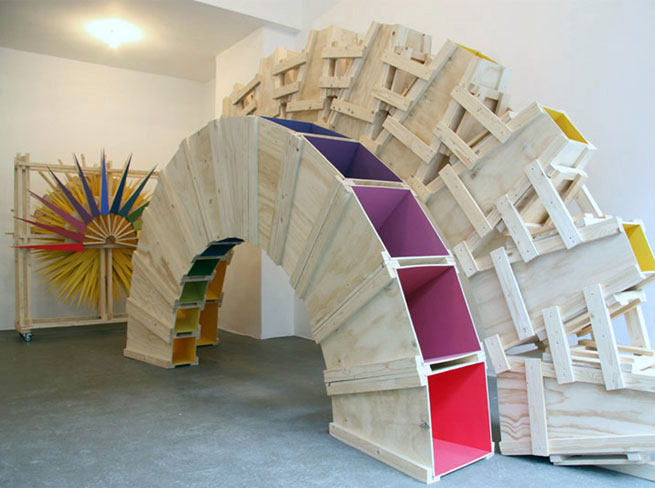
The fake, the future and the finite (A commemoration of the absolute in the 21st Century) Part 1: Sun, Rainbow, Arch, (reinvented), 2007 / 2008 Wood, acrylic, reels, 500 x 50 x 270 cm, 300 x 50 x 200 cm, 200 x 100 x 200 cm. Photo: Ariel Levin. Image � Alon Levin
Structure and Hybris An interview with Alon Levin, by Mihnea Mircan contd
MM: If I read this correctly, the work visualizes precisely the mutability of order, the minute dislocations and reconfigurations that could finally articulate � or propel -, a paradigm shift in how an object or an idea is conceived and used. And it does so by complicating things, rather than stripping them bare, by being that provisional deferral, however pleonastic this may sound. The combination of vulnerability and ambition that struck me with �Another Attempt�� is perhaps the Order � dominating, powerless, strenuous, never declaring itself to be the temporary armistice of Orders -, that traverses European culture. What are the histories, of art or thought, that you connect your practice to? And how, given the overwhelming historical load in your work, would you visualize the art history of today? This is a professional reflex, but also a proposal to outline what I sense is your look at the origins of abstract art.
AL: I am interested in the Renaissance study of classical antiquity in the pursuit of depicting ideal form, just as much as I am interested in Modernism�s rejection of this tradition in order to bring about a utopian society, free of indoctrinated ideals. For me, this bipolar notion of formal or conceptual value and meaning points to the fundamentally questionable relationship between knowledge and progress. I�m drawn to the moments in art history where these types of philosophical conflicts arise, where elaborate models are created to settle questions of truth, and where - incomplete and self-referential as they may be - ideologies are ultimately formed. I envy the idea of the �Renaissance Man� in contrast to the disciplined Modernist: the well-educated genius who masters sculpture, painting, biology, architecture, philosophy, and physics� Still, in Modernism too there is this model within the Russian avant-garde: a well-educated artist mastering painting, sculpture, design, architecture, and photography� But unlike these two archetypes, I am not searching for new ideals and utopias, nor do I look for a mathematical truth or technological answer. I am interested in the possibilities that occur outside these defined ideals, the place where systems collapse and cease to function and where new, as-of-yet undefined situations occur. The work is a process of engaging, cross-referencing, and organizing a mass of things and information that would be otherwise discarded as irrelevant, left outside the construction of the Model. For my upcoming exhibition �Postponed Modernism� I will have a series of works celebrating man�s striving for the perfection of form. Works by Albrectht D�rer, Kazimir Malevich and the Ferris wheel of the 1893 Chicago World Fair are some of the starting points of the works on show. A colossal wheel will dominate the main exhibition area; it is titled �Untitled, a Proposal for a Universe Under Control� and it is there as a sketch or a thought to capture and order all things. Next to it will hang a massive black and white wall installation titled �A Large Inverted Standard Brain on The Wall�. It is a painting of a big white circle, defined by a framing black square - thus the opposite of the standard brain. In the back room there will be another smaller installation titled �An attempt to Rediscover the Power of Imagination II�. It is a painting of an incomplete dodecahedron on a panel mounted to the wall with an elaborate system of wooden crossbars and supports beams that jut the painting out from the wall. On the floor in front of it stands a red monochromatic wooden chair. The complex wooden structure and the dysfunctional character of the chair both emphasize the nature of presentation, the mechanisms of persuasion, and the validation process of the Grand Idea (an attempt to construct another greater structure).
Printed as a supplement to Alon Levin�s exhibition, Postponed Modernism at KLEMM�S, Berlin (9.1.2009 - 14.2.2009). Mihnea Mircan is an independent curator living and working in Bucharest, Romania. This interview is part of an ongoing conversation between Alon Levin and Mihnea Mircan that started in June 2008. � Alon Levin, 2009
* Image 6
Alon Levin�s (ISRL, 1975) work bears witness to an significant interest for the philosophical, economical and social theories that underlie reality. He questions and analyses social or political systems and processes, and expresses his ideas in room-filling installations in which wooden structures play a major role. The installation in de Appel is part of a series of five that examines mans� persistent attempt to instil things with meaning; man's need to order, control and name the world around him and the metaphors and symbols he uses to effectuate this. The tower, as in the biblical Tower of Babel or the Modernist Tatlin Tower (conceived as a communist technological utopia) is a celebration of contemporary technology: a monumental representation of progress. The spiral bears the same connotation, being a curve running continuously around a fixed point in the centre while constantly receding it. Though it is just a line evolving around itself in a circular manner; an eternal pursuit of an end point that is not defined. It is in reverse to a donkey lead by a carrot, were a well defined unattained end point is symbolized by an orange carrot. Both though are in an eternal pursuit of an unreachable something, weather a defined one or not they represent progress, define their own context and centre of attention while ignoring their surroundings.
Gerbrand Korevaar De Appel
Alon Levin (New York/Den Haag) makes large-scale installations often made of wooden structures that refer to the systems of thinking we tend to take for granted. Philosophical, economical, and social theories of progress and growth, organizing principles, and ideas of modernist utopias are some of the recurring themes in his work. Levin examines the images, metaphors, and symbols that represent these concepts, and explores the contradictions and failings of their systems. The work can be seen as a narration about the buildup, breakdown, and possibly the reinvention of meaning itself.
Levin�s method and aesthetic approach: in the beginning he establishes parameters and a course of action; then a process starts in which he reacts to, examines, and eventually playfully breaks these same parameters. Alon Levin develops modules of what appear to be color and image systems that are prevalent throughout his work. Basic forms like tower, spiral, arch and wheel continuously reoccur � all bearing the connotations of technical progress, movement and monumentality. The installations� overwhelming physical presence and the spatial quality they force onto the viewer establish a kind of logic that transforms the context and creates a momentary alternative reality. The structures have a material rawness and this underlines the transparency of the process and sketch-like nature of the installations.