
|
Alix Smith Page 1 | Biography |
|||||||||
|
|||||||||
Constructed Identities 11
|
|
||||||||
|
Through Imitation
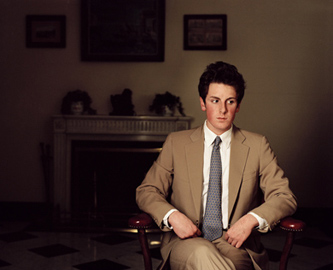
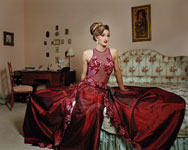
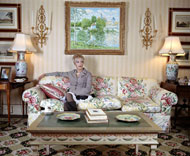
My project explores the concept of identity and gender as the product of cultural and social influences. Throughout our lives we take on traits and imitate those whom we identify with regardless of gender. These traits and influences are internalized and consequently performed, through the characters of “Truly Fabu” and “Ingenue.” My subjects are drag queens who call upon their background to formulate their created identities. Their transformation liberates them allowing them to transcend limits of gender, creating an alternate reality. I photographed two drag queens who had grown up in middle/upper class households. Separated from the judgment of the outside world, I photographed them in the apartment in which one of them grew up. Employing the costumes and poses of the upper class, they take on the cultural stereotypes of the world in which they grew up. They present exaggerated versions of their society creating an alternate reality. At first glance the images look like photographs one might see in Town & Country magazine, however, as one looks more closely, one observes the breakdown of conventional notions of reality, where gender is flipped and inconsequencal. |
|||||||||
|
Deluze’s asserts that if the truth of the image is not visible, then no independent perspective can be established in order to make distinctions between real and unreal. Therefore, the object is only a “simulated resemblance” of the original, and has its own unique meaning.
|
Through Imitation 4
|
Through their imitation we are able to observe the artificiality, not of their performance, but of the performance of the stereotype they are imitating. The gender of the actor does not constitute originality. The performance of a drag queen’s character is closer to the truth, then what society deems as the original, because they are consciously aware of their character.
|
|||||||
|
|||||||||
International contemporary art



SIGN UP FOR NEWSLETTERS
 SERVICE OVERVIEW
SIGN UP for ARTIST MEMBERSHIP
SIGN UP for GALLERY MEMBERSHIP
NEWSLETTERS & ANNOUNCEMENTS
NEWSLETTER SCHEDULE
ARTIST OPPORTUNITIES
POST ARTIST OPPORTUNITY
SERVICE OVERVIEW
SIGN UP for ARTIST MEMBERSHIP
SIGN UP for GALLERY MEMBERSHIP
NEWSLETTERS & ANNOUNCEMENTS
NEWSLETTER SCHEDULE
ARTIST OPPORTUNITIES
POST ARTIST OPPORTUNITY
Click on the map to search the directory