|
On a summer�s day the philosopher Pao Cheng sat down on the bank of a stream to foretell his destiny in a shell of a turtle. Before the eyes of his imagination, great nations fell and small ones were born which later became great and powerful before falling in their turn. The force of his imagination was such that he felt himself walking through its streets. Through one of the windows, he could make out a man writing. Pao Cheng then looked at the sheets of paper lying on an edge of the table and as he went on deciphering the meaning of what was written in them his face clouded over. �This man is writing a story�, he said to himself. �The story is called La historia seg�n Pao Cheng and it is about a philosopher from the olden times who one day sat on the bank of a stream and thought about� Then if I am a memory of hat man and if that man forgets me, will I die?� We, or rather our illusion, is what operates in this redoubled world; this is done so up to the point that, like Pao Cheng, we can no longer distinguish between realities and appearances.
|
|
We, or rather our illusion, is what operates in this redoubled world; this is done so up to the point that, like Pao Cheng, we can no longer distinguish between realities and appearances.
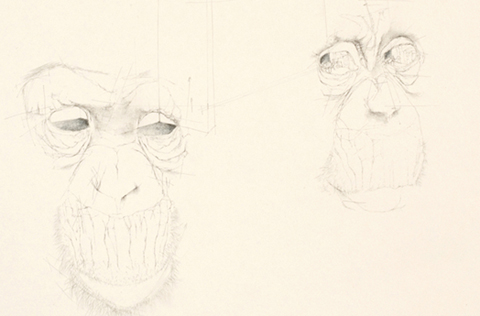
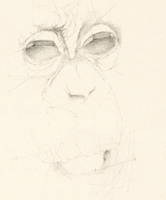
If we think of Alexandra do Carmo�s work in a retrospective manner, some keys to it are revealed. If in Office/Commercial (2007/2008) she explores the transformation of spaces, in A willow (or without Godot) (2006) it is the spectator�s behaviour that is seen, taking Beckett�s well-known play as a starting point. In previous works the creative process (untitled drawings, 2006); the literal and symbolic creation of a workshop by the artist and other workers using the specific language of art to question virtual proximities (Argon Corporation, 2004/2005); the immodest gaze of a spectator at the inside of the workshop through a microscope (50 Richards, 2004); the relationship between the artists activity and that of a palaeontologist (Wild m5, 2004); or the spectator as author at the time of producing (Micron 005, 2002/2004); tell us of a concrete search: to bring the spectator close to the work, both physically and conceptually. The first approximation is obvious: whether this is looking through a microscope or forcing him to physically come close to the drawing in order to understand what is taking place inside the eyes of the chimpanzee or the motif of some dinosaur heads makes the reception physical.
Meanwhile, conceptual approximation takes place almost in the opposite way: in se
|
almost in the opposite way: in seeking a direct confrontation a break in the discourse or the event is produced. Here the mistake, like in the act of drawing, takes place �where stating is impossible�, in the incomplete and impossible aspect of all communication, in the now metaphorical difficulty that flows from the choice of the animal itself.
In Office/Commercial it is not the first time she has approached the complexity of the idea of the artist�s workshop. Before, for example, the deconstruction of the essence of the workshop took its starting point in Courbet�s painting (The Painter�s Studio) in order to reformulate the notions of the public and the private and the new models of post-production and representation. With her shiftings, Alexandra do Carmo makes her attitude political, seeking to intervene on the social sphere in a critical manner, showing and granting greater presence to the process. And always from anthropological performances and collective field work capable of uniting the non-artistic social aspect with the specifically artistic one.Deep down this underlines a deconstructive style that we may compare to some words by Italo Calvino: �Kublai Khan had stated that Marco Polo�s cities were alike, as if moving from one to another did not involve a journey but a change of elements. Now, from each city that Marco described to him, the Great Khan�s mind went off of its own accord, and dismantled the city bit by bit, rebuilt it in a different way, replacing ingredients, displacing them and inverting them. Marco went on referring to his journey, but the emperor was no longer listening to him and interrupted him�.
|