|
AHMED ALSOUDANI Page 1 | 2 |
||||
|
||||
|
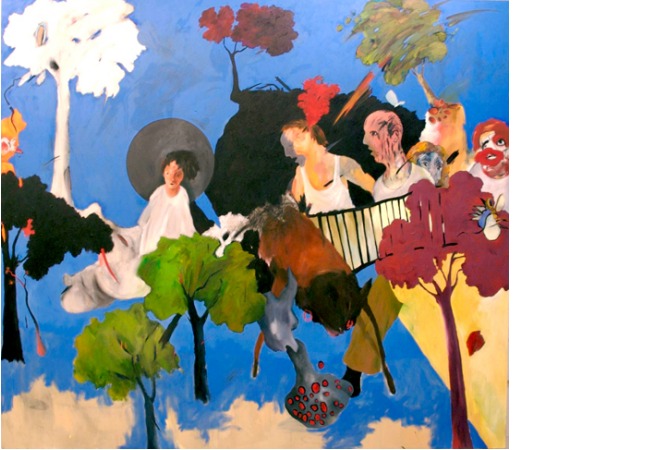
Alsoudani presents depictions of all too familiar confinement, deposition, and the scavenging of decay. His exploration into the narrative potential of pain has a long tradition in religious, political, and sexual modes of representation, neither of which fully locates his work � eluding transfiguration, hope, and pleasure. So how is it we are caught looking at his work with such little emotional reward? In her Regarding the Pain of Others, Susan Sontag suggests scenes of the terrible transfix �To steel oneself against weakness. To make oneself numb. To acknowledge the existence of the incorrigible.� Likewise, Alsoudani�s work fills certain psychological needs in relation to power to remind us and reconnect us with violence at large. |
||||
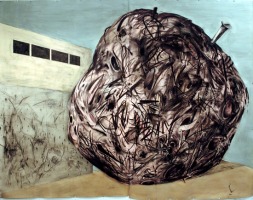
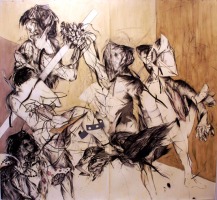
Images from top: If there were anywhere but desert, 2007 oil on canvas, 96 x 84 inches. You no longer have hands, 2007 charcoal pastel and acrylic on paper, 108 x 84 inches. We Die Out of Hand, 2007 charcoal pastel and acrylic on paper, 108 x 96 inches. |
The American response to war is one in which a general anesthesia and distance to raw power and destruction is supported and, at the same time inevitable. Alsoudani cannot escape the reality of terror abroad so easily as he was born in Iraq and experienced a gamut of dictatorships first hand in Baghdad, Syria, Jordan, and Lebanon. He claims, "struggling is a daily issue . . . living with the war minute by minute." So, his work functions more as a documentation of his responsiveness to charged situations rather than a fixed journalistic approach. In this sense, he responds actively in his formal decision-making, always present in the process. His point of view as an American citizen with a very distinct background contributes to his position that the past does not exist. As history relegates events to a conclusion, he sees in a constant present in which the horrors of the past constantly replay and afflict the present.
- Text by Richard Goldstein
|
|||
|
||||
re-title.com
International contemporary art
SIGN UP FOR NEWSLETTERS

 SIGN UP for ARTIST MEMBERSHIP
SIGN UP for GALLERY MEMBERSHIP
SIGN UP for ARTIST MEMBERSHIP
SIGN UP for GALLERY MEMBERSHIP
Click on the map to search the directory