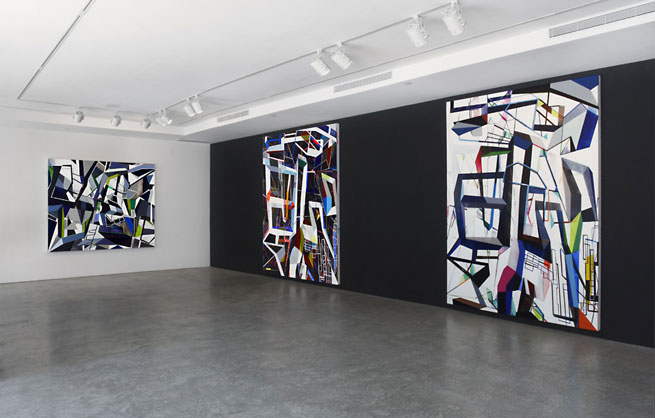
This impression of a completely contrived structure drawing its dynamism from big-city life became the inspiration for his final works. The interpretation laid out in them � the idea of a purely planar, abstract painting style as a non-mimetic depiction of vibrantly complex space � contains aspects to which Giehler�s work is also linked, and which he continues to develop on many levels.
[...]
Even when Giehler�s paintings radiate cool virtuality, revealing colour-saturated artificiality and captivatingly perfect surfaces, the process of pictorial invention is never computer generated, but rather takes place directly on the canvas. Giehler begins with a freehand drawing, such as a grid or abstract form. �Not really anything concrete,� he says, �sometimes a perspective can be seen; what is important is to initially get some paint on the canvas, and then I go from there. There are no detailed sketches or preliminary drawings, and therefore no mere act of transference.�(1) Giehler develops his paintings on their supports directly on the wall. �Thus they cannot be rotated or turned upside down. Yet in Photoshop � the only program I use � I can turn them any way I want. If a horizontally hung painting then becomes a vertical work, I nevertheless continue to paint it in its horizontal orientation. Not until the canvas has been stretched on the frame can I really get a look at it.� He creates the paintings in a complex and artistically open process, into which he integrates references to other media. Often, however, it is at this point that the process really gets going: Giehler photographs the piece in its intermediate state, and may then �draw further with Photoshop. I add forms or cut something out�, he says, to then take these results and return to work on the canvas. �Processes such as these can fundamentally change the painting almost daily,� he states. Technically-assisted virtuality and a tangible painterly character � both of these alternately provide the stimulus for a linear development of the picture that can neither be planned nor predicted. This goes on until things look just right.
The special appeal of this unconventional hard-edge style with its semblance of virtuality is also due to its material side: The intensive, glowing colours are half translucent (which can hardly be reproduced adequately in reproductions). Giehler does not use oil paint, but acrylics, and he mixes them liberally with a special gel. �This makes the paint so translucent that you can see through two to three layers, and so the tones mix with each other like coloured transparencies.� He augments this special colouration even more by using fluorescent colours such as are available in specific tones of orange, pink, green, and blue. In linking elements and effects like these, Giehler creates complex, rhythmic colour spaces that draw viewers into the painting, and which themselves appear to be escaping over the painting�s edge. The apparent smooth perfection of these paintings, the assertion of pure surface(s) together with their transparency � all this contrasts with Giehler�s freely abstract and dynamically expressive conception of form, and with the spatial design, seemingly kaleidoscopically fragmented, he derives from it.
�What do I want to express in my work? To achieve all-encompassing beauty and harmony through the balance of the relationships between lines, colours, and planes. But only in the clearest and strongest manner.�(2) That was how Piet Mondrian formulated his aesthetic aspirations, from which starting point he postulated abstraction as the transformation of spatial and object relationships towards the universal. In a very comparable way Giehler has set his sights on beauty; he too is concerned with strong, clear relationships between lines, colours, and planes. Yet he also radically rethinks pictorial space in terms both of its artificiality and its virtuality. In this, structure no longer refers back to a principle of nature, and to this extent it also has no metaphysical basis. Simultaneously it becomes the vehicle of a liberated imagination, which now completely redesigns pictorial space without restraint. This is the type of freedom Giehler adopts here, with an eye for the beauty of paintings that are just as multi-focal as they are open, and abstract to the core. Completely non-representational. In the clearest and strongest manner.
(1) All quotations except (2): Torben Giehler by e-mail to the author
(2) Quoted from Hans Janssen, �Piet Mondrian�, Prestel Verlag, Munich 2005
page 2 of 2
Jens Asthoff Submerging in colour space Abstraction by Torben Giehler
Catalogue Text "Falkenrot Preis 2008" Bethanien Berlin, Germany
Torben Giehler
New York, NY
New York
North America