|
Rebecca Hackemann Page 1 | 2 | 3 | Biography |
||||
The Flapper
|
||||
|
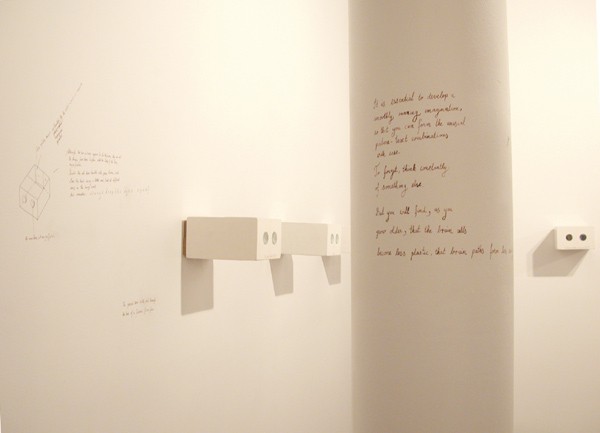
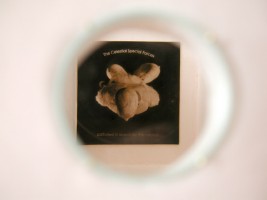
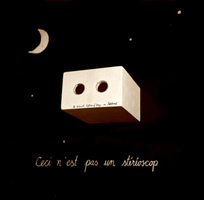
Contained inside the white boxed optical sculptures are black and white photographs, that become three dimensional when one looks through the lenses, creating a spatial illusion of something photographic, yet completely imagined (by 'The Institute of Incoherent Geography'). One of my interrests is the Cartesian structure of vision, in which subject and observer are separate entities as well as collapse and challenge the boundaries of photography and sculpture, old technological wonder and new. The relation of observer to image is no longer to an object quantified in relation to a position in space, but rather to two dissimilar images whose position simulates the anatomical structure of the observer's body. Jonathan Crary, Techniques of the Observer |
||||
The Flapper
Rebecca Hackemann was raised and educated in Bavaria, West Germany, England and America. She is British and lives in New York City and works from her studio in Williamsburgh, Brooklyn, NY. She completed her B.F.A (hons) at the University of Westminster, London, England and in 1996 received her M.F.A. in studio art from Stanford University, California. She is also a graduate of the Whitney Museum of American Art's Independent Study Program (2001). Her mini artists books (Scaled Down - a Handbook for Fishes about Humans, 1996)can be seen and purchased at Printed Matter, New York and are also in the art*o*mat machines. She recently completed residencies at Light Work, Syracuse, NY and Yaddo, Saratoga Spring, NY. Her work is in the collection of the Mus�e Fran�ais de la Photographie, France; the Staatliche Museen zu Berlin, Germany; the Museum f�r Fotografie, Germany an in private collections in New York and England. |
Influenced by photography such as that of John Heartfield and English literature, photography, language (both in the image and on the gallery walls) and sculpture are combined into �photo based� work or optical sculptures that humorously address contemporary political and societal issues as well as language and how it's meaning is constructed. The work most often consists of an installation of handwritten text on the walls as we well as hung white boxes, which the viewer peers into through 2 lensed peepholes. Inside these optical sculptures are stereoscopic black and white constructed photographs (silver gelatin prints) of a fictional world with text. By looking through the lenses the viewer sees the images in 3-D� thus the sculpture acts as both a stereo viewer and a conceptual container with it�s own inscriptions. These three dimensional constructed black and white photographs inside white optical viewing sculptures reflect a critical, humorous and questioning view of the world seen layered through the lens of a future memory of a fictional place. The viewer is prompted to "peek, "look" or "see" and thus becomes a participant, a performer and a challenger within the Cartesian structure of vision. This work is also often displayed as public art in windows.
Tribute to Foucault |
|||
|
||||
re-title.com
International contemporary art
SIGN UP FOR NEWSLETTERS

 SIGN UP for ARTIST MEMBERSHIP
SIGN UP for GALLERY MEMBERSHIP
SIGN UP for ARTIST MEMBERSHIP
SIGN UP for GALLERY MEMBERSHIP
Click on the map to search the directory