|
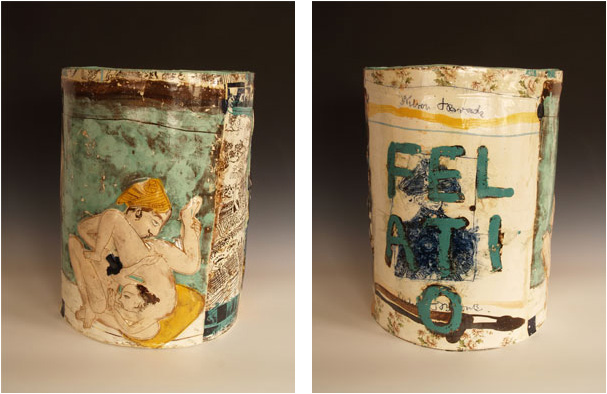
Philip Eglin�s work carries references to a heterogeneous array of sources. Inspiration for recent figures comes from Northern Gothic religious woodcarvings, Chinese export porcelain, English folk ceramics and the language of symbols used on contemporary packaging. His interest in such artefacts is not solely because of their intended aesthetic, but extends to the characteristic shapes and marks that are found on the underside and backs of things.
|
|
He is concerned to achieve �... a balance between the high and the lowbrow, the reverent and the irreverent, the raw and the subtle, the sophisticated and the crude �. These interests and intentions are embodied in a recent series of porcelain Madonnas. Capturing the raw power of early religious statuary and their characteristic scars of time, they also bear traces of prosaic modern consumer culture - such as the vestigial imprint of a squashed plastic bottle that was used in the moulding of a body, and in the commercial symbols discovered on the limbs and drapes of the figures.
Born in 1959, Eglin trained at Staffordshire Polytechnic and at the Royal College of Art. His work can be found in the collections of the Stedelijk Museum, Amsterdam; National Museums of Scotland, Edinburgh; Fitzwilliam Museum, Cambridge; and the Victoria & Albert Museum, London.
He was the winner of the Jerwood Prize for Applied Arts: Ceramics in 1996.
|
Images from left to right from top :
Kiss Me Hard On (Felatio Nelson), 2007
DIMS: 22 x 17 inches / MEDIUM: Earthenware
Philip Eglin
Kiss Me Hard On (Felatio Nelson), 2007
DIMS: 22 x 17 inches / MEDIUM: Earthenware
Philip Eglin
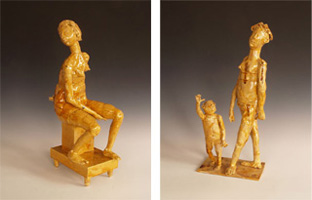
Seated Nude, 2007
DIMS: 21 x 10 x 8 inches / MEDIUM: Earthenware
Philip Eglin
Venus et Amour, 2003
DIMS: 17 � x 8 x 7 inches / MEDIUM: Earthenware
Philip Eglin
Kiss Me Hard On (Felatio Nelson), 2007
DIMS: 22 x 17 inches / MEDIUM: Earthenware
Philip Eglin
Let Us Play, 2006
DIMS: 22 x 17 inches / MEDIUM: Earthenware
Philip Eglin
|