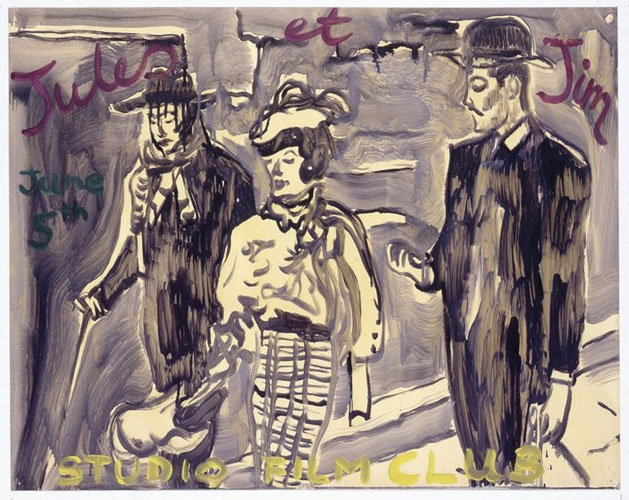
STUDIO FILM CLUB - Peter Doig, Jules et Jim, 2003 oil on paper, 57 x 72 cm / 22 3/7 x 28 1/3 in Image � Peter Doig, Courtesy Contemporary Fine Arts, Berlin
Doig's first break, and the first money he made, came in 1993 when his painting Blotter won the John Moores Prize. The painting, though apparently naive, carries the intensity that Doig is able to invest in his surfaces. He describes the way people look at paintings as 'different from how they look at anything else; it's a strange, lost scrutiny ...' Blotter demands this gaze. It depicts a single adolescent figure standing alone on a frozen lake dwarfed by the woods and ice around him; it invites many questions, not least the relation of the figure to his teenage self.
'I understand it completely as something autobiographical,' he says, 'though I don't know it's easy to explain.' The painting partly grew out of a photograph he had taken of his brother, after they had deliberately flooded a frozen pond to see the effect the water had on reflection. 'The figure is not doing much, standing there, contemplating, moving his foot. But then there is this other stuff around. The painting is about noticing that stuff really - all my painting is concerned with something like that.'
The blotter of the painting's title is a reference to the LSD that Doig used occasionally as a teenager 'without being a total acid head like some of my friends'. Looking back, he suggests 'it was an important, sometimes terrifying drug to experiment with, though only people who have taken LSD would really understand how it might have affected my work. Blotter tries to catch the idea of all this activity in the head, but the body being still. It is something like being absorbed into the landscape, I suppose.'
Doig stopped taking psychedelic drugs when he was 18, but the experience remains a reference point. His paintings often feel very much like distant products of the Seventies, dwelling on damaged utopias, though he is anxious to loosen their moorings: 'Painting becomes interesting,' he says, 'when it becomes timeless.'
As a result, his best work occupies some uneasy space between anecdote and abstract; it never lets you forget either its reference in the real world, nor its painterly surface. Alongside his canoe pictures, the best expression of this is perhaps his 'Concrete Cabin' series, made in 1994, which also casts light on some of his recurring preoccupations. These paintings were all based on a near-derelict Corbusier building at Briey-en-For�t in north- eastern France, which Doig stumbled upon while walking in adjacent woods. 'The building took me by surprise as a piece of architecture,' he says, 'but it was not until I saw the photographs I had taken of the building through the trees that it became interesting. That made me go back and look at it again. I was surprised by the way the building transformed itself from a piece of architecture into a feeling. It was all emotion suddenly.'
Some of this emotion he brought with him, some of it seemed centred in the place itself. 'The building is in a strange, sad part of France, very close to Verdun,' he says, 'and just approaching the town you are immediately aware of what went on in the First World War and the Second World War. In the town, there is a graveyard with lots of black crosses on the graves of German soldiers. The woods have a sombre feeling that there is no getting away from. The paintings could not help but contain that.'
Such a romantic idea of painting was violently at odds with the sensation and irony of many of Doig's contemporaries, but eventually the market, and Saatchi, started to come round to his way of thinking (a shift which culminated a couple of years ago in Saatchi's show The Triumph of Painting, in which Doig starred alongside Martin Kippenberger and others). It is tempting to think he moved to Trinidad to escape the venality of the London art world, but it was less complicated than that. 'It was more to do with being excited by somewhere else,' he says. 'And giving my family some of the childhood I'd had. I went back to Trinidad in 2000 with Ofili; we were doing a residence together. He and I went back maybe seven times in the next three years - at any opportunity. One time, we were in a group show in Los Angeles and we managed to blag a ticket to go via Trinidad for two days - a crazy journey. It just got to us. I bought a piece of land when I went there in 2000, which wasn't something I would have imagined that I would do. It seemed like a good alternative to London, because, although I had left there when I was seven, it was so familiar to me. I could still remember my way around.'
He and Ofili are now embedded in Port of Spain culture; Doig runs a weekly film club in his studio that attracts a 'proper Trinidad mix' of people to watch the likes of Black Narcissus and The Big Lebowski. The flyers for the films are probably worth holding on to - Doig paints them himself.
Since he has been in the Caribbean, he has stopped painting so much from photograph and memory and started responding to what is around him, Gauguin-like. He takes boat trips, sometimes with Ofili, to the wild northern coast: 'Incredible landscapes and caves and archaic spaces like natural cathedrals, chasms, strange pelicans, islands covered in their shit.' Does being there make him want to collapse the idea of what a Peter Doig painting is? 'You always want the paintings to have some freedom; the good ones always had that; they were escaping from what you had done before.'
Those escape routes are often tortuous; Doig works slowly, finishing maybe six or eight paintings in a year. The process of finding endings still troubles him. 'Basically, I am always trying to resolve something. It is sometimes a technical thing, usually involving drawing, which I'm not very good at, and it is always one of those things you can only get to by making it. Just scrape it off and start again. It is often a fluke until you eventually get there.' He talks of his work with great modesty and with a sense of vocation. He's not sure he wants the extra pressure of fame. 'This might sound strange, but I never thought of them as being particularly good paintings. I wasn't trying to make an anti-painting or anything, but I certainly enjoyed the idea that there was a lot of bad painting involved in them. That trips you up, too, though. What is bad painting? Picabia made some deliberately bad paintings, but they were by him, so great in a way.'
In that sense does he fear, now he is the most expensive painter in Europe, that he can do no wrong? 'Oh,' he says, laughing, 'I'm pretty sure I can still do lots of wrong.'
Doig's life
1959 Born in Edinburgh 1962 Moved with his family to Trinidad, where his father worked for a shipping company, and then to Canada in 1966. 1979 Returned to Britain to study at the Wimbledon School of Art. 1980 Began a BA at St Martin's School of Art where he became friends with artist, writer and musician Billy Childish. 1984 Hosted his first solo gallery exhibition at the Metropolitan Gallery in London. 1994 Nominated for the Turner Prize for an exhibition of paintings at the Victoria Miro Gallery. At that time his paintings sold for about �8,000. 1995 Made a trustee of the Tate Gallery, a position he held until 2000. 2002 Returned to live in Trinidad. 2007 Became Europe's most expensive living painter when his 1991 painting White Canoe sold at Sotheby's for �5.7m.
condt from page 2 Tim Adams The Observer, Sunday 27 January 2008