
|
John Hawke Page 1 | Biography |
|||||||||
|
|||||||||
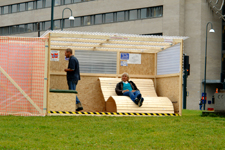
Rest Area–Open House
|
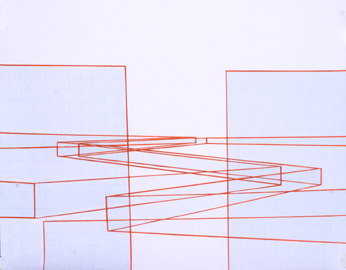
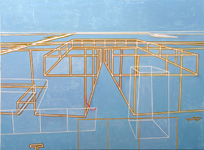
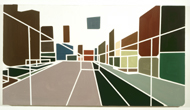
The drawing and painting work, synthesizes this experience in terms of metaphor, creating visual analogues for the constitution and degradation of public space as an ongoing process of enclosure, collapse and interdiction.
|
|
|||||||
|
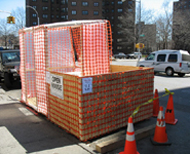
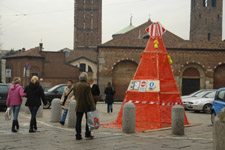
The architectural interventions, a collaborative project, entitled Orange Work, (begun in 2002 with Sancho Silva), takes the form of “extralegal” or unauthorized bus shelters, benches, information kiosks, or rest areas, aim to create “differential spaces,” rupturing the prevailing spatial logic of the commercially pragmatic urban environment through interventions that necessitate a re-negotiation of public property and right of use.
The primary organizing conceit has been to appropriate the authoritative spatial semiotics of florescent orange from authority actors, which orders “look here,” “stand back,” or “keep out,” and use these representations of space as a means of spatial agency. The constructions introduce an element of the uncanny, as they combine usurped semiotic codes within forms intended to provoke friction within the machinery of power—a form of spatial jamming. The audience is both twofold and opposing: the local residents of the site, who are the intended users, and the state, with its overlapping yet self contained networks of control—from sanitation police to building inspectors and roving patrol cars, all of whom must regard the work with paralyzing uncertainty. |
|||||||||
|
The interventions are maintained over time creating a dialectical situation of spatial control as the structures elicit counter-responses from capitalized forces that see the semiotic confusion as detrimental to the efficacy of their markers of spatial dominance. Video is used within this context to document the creation of the structures and their reception in the field of social relations. |
|
Currently attending the Whitney Museum Independent Study Program, he completed a Master of Fine Arts Degree in painting at Pratt Institute in 2002. He is a recent recipient of a fellowship from the Kress Foundation and exhibits his work though the Michael Kohn Gallery in Los Angeles and through Pace Editions in New York.
|
|||||||
|
|||||||||
International contemporary art
SIGN UP FOR NEWSLETTERS
 SERVICE OVERVIEW
SIGN UP for ARTIST MEMBERSHIP
SIGN UP for GALLERY MEMBERSHIP
NEWSLETTERS & ANNOUNCEMENTS
NEWSLETTER SCHEDULE
ARTIST OPPORTUNITIES
POST ARTIST OPPORTUNITY
SERVICE OVERVIEW
SIGN UP for ARTIST MEMBERSHIP
SIGN UP for GALLERY MEMBERSHIP
NEWSLETTERS & ANNOUNCEMENTS
NEWSLETTER SCHEDULE
ARTIST OPPORTUNITIES
POST ARTIST OPPORTUNITY
Click on the map to search the directory