
|
JAMIE SHOVLIN Page 1 | 2 | Biography |
||||
|
||||
|
LUSTFAUST: A FOLK ANTHOLOGY 1976-1981 Curated by Jamie Shovlin from the Archives of Mike Harte and Murray Ward June 15 – July 22, 2006, Freight + Volume |
||||
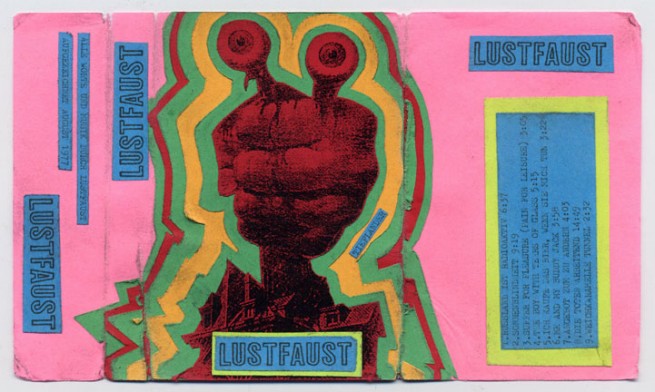
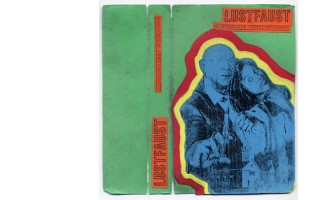
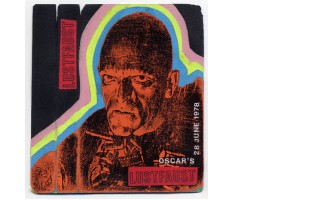
This statement, taken from the only existing Lustfaust website, was my formal introduction to Lustfaust so I see no reason why it should not be yours. The pair responsible for the website, Mike Harte and Murray Ward, have been researching the legacy of Lustfaust for almost a decade and the website, originally intended to encapsulate the band’s history and musical legacy, has evolved into something far more personal for its subject, creators and users. Ever since my first encounters with Lustfaust, the archivists and with the transatlantic rabble of Lustfaust fans actively engaged in the website’s assembly, the prospect of an actual physical exhibition has appealed to us all. Jamie Shovlin, Lustfaust Collage and acrylic on paper (13 covers), 8” x 4” Jamie Shovlin, Lustfaust Collage and acrylic on paper (13 covers), 4” x 4” Jamie Shovlin, Lustfaust Collage and acrylic on paper (13 covers), 4” x 4” All works collection of Barry Scott (Luton, UK) |
Lustfaust was an experimental noise band active in West Berlin during the late seventies and early 1980s composed of a group of ession musicians. Featuring a Japanese jazz drummer, Matsushita ‘Bobby’ Kazuki, a Belgian guitarist/multi-instrumentalist, Guido an Baelen, a German bassist, Hans Berger, and the California- born, German/American Peter Kruger, the band was a curiously nternational mixture, initially formed through a mutual distaste for the inoffensive music that it was for the most part their job to produce. Their combination of an aggressive on-stage presence, instrumentation through found objects such as cement mixers
and pneumatic drills, and the use of an anti-capitalist community-based model of distribution (if you sent the band a blank cassette, they would return it with their latest release) spawned the Dadaist Geniale Dilettanten movement of the early 1980s and pioneered he burgeoning cassette culture of the late seventies.”
|
|||
|
||||
International contemporary art
SIGN UP FOR NEWSLETTERS
 SERVICE OVERVIEW
SIGN UP for ARTIST MEMBERSHIP
SIGN UP for GALLERY MEMBERSHIP
NEWSLETTERS & ANNOUNCEMENTS
NEWSLETTER SCHEDULE
ARTIST OPPORTUNITIES
POST ARTIST OPPORTUNITY
SERVICE OVERVIEW
SIGN UP for ARTIST MEMBERSHIP
SIGN UP for GALLERY MEMBERSHIP
NEWSLETTERS & ANNOUNCEMENTS
NEWSLETTER SCHEDULE
ARTIST OPPORTUNITIES
POST ARTIST OPPORTUNITY
Click on the map to search the directory