A strong sense of biography�who they are, where they are from�is at the heart of the Tobiases' work, all of which is made collaboratively. As twins they relate to each other in a much closer way than most brothers; as artists they think of themselves almost as one person, cosigning all of their work no matter who did what. They maintain three studios, only one of which is completely shared, a room in the apartment where they live. This is where the original woodcuts are made, as well as works on paper. The large woodcuts are printed and assembled in their separate studios, but they visit and critique each other, discuss what they will work on, share ideas. It may at first seem an unusual collaboration, and yet it is collaborative in every sense of the word. It is impossible to look at anything they produce and assign it definitively to one or the other. In fact, there are times when one will see something the other is working on and ask to finish it�although the response isn�t always positive�or one will tell the other to finish something he started. They also admit to "copying" each other. Gert might redraw something he'd seen by Uwe (or the other way around), then change it, adapt it in some way. This has been going on for years and is by now a fully reciprocal exchange. Think of it as the surrealist parlor game of exquisite corpse played as part of a continuous working process. Having time and space to themselves guarantees that within the shared identity of the Tobias brothers there is still Gert and there is still Uwe. It's important that each sees himself in the work, and even if we don't, they do.
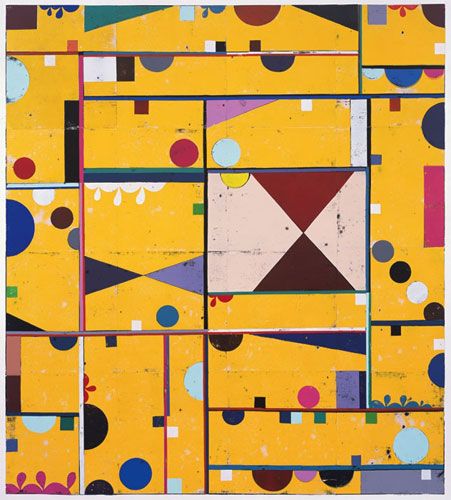
The woodcuts begin with drawings, and although they use a machine to cut the wood, there is very much the feel of the hand, because, as they say, "We draw with the machine."(1) Even then, they don�t always cut out the forms exactly, and decisions made at the time of printing also introduce a human element. The amount of pressure applied when a block is printed affects the texture of the surface, which may appear slightly worn or rubbed, bearing traces not only of its making but also of the history behind their subjects. The woodcuts�characterized by a sober, earthy palette, and with lettering that appears incised�have a crude sophistication. Their works feel as if they have been passed down over time. The watercolors and drawings are incredibly evocative, ethereal, otherworldly. The figures in them can be hauntingly beautiful, poignant, poetic. There is a depth of feeling in their work that resonates with this sense of time, of myths, legends, and death. It comes as no surprise that they have expressed an affinity for the great symbolist James Ensor, an artist for whom mortality and the idea of masking identity are central. The outsider artist Henry Darger also comes readily to mind, with his scenes of battle, torture, and the taking of life. The graphic quality of their abstract works evidences the influence of constructivism, particularly the printed agitprop that we immediately associate with the Russian avant-garde.
For the Tobias brothers, the ability to make figurative and abstract works, for their work to take different forms�woodcuts, typewriter drawings, sculpture, ceramics, watercolors�is paramount. There are two of them: two minds, four hands, a completely shared sense of purpose. This is their world, and they are in it together.
contd page 2
page 2 of 2
Bob Nickas is curatorial adviser at PS1 Contemporary Art Center in New York.
Notes
1. Gert and Uwe Tobias, conversation with the author, Cologne, July 9, 2006.
|
Gert and Uwe Tobias
Cologne
Germany
Europe
T: 0
F: 0
M: 0
|
|
Web Links
Galerie Michael Janssen, Berlin
Galerie Rodolphe JAnssen, Brussels
The Happy Lion, Los Angeles
Team Gallery, New York
|
|

 SIGN UP for ARTIST MEMBERSHIP
SIGN UP for GALLERY MEMBERSHIP
SIGN UP for ARTIST MEMBERSHIP
SIGN UP for GALLERY MEMBERSHIP