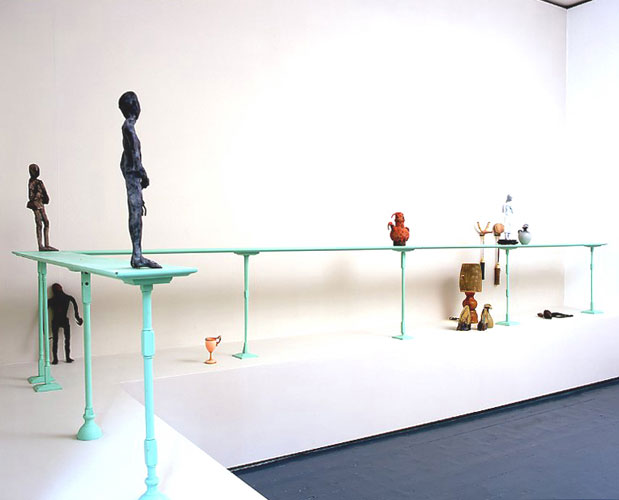
Francis Upritchard, Installation View 2006 at Kate MacGarry Gallery, London, 22 September - 28 October 2006 Image � the artist. Courtesy Kate MacGarry Gallery, London
So what is Upritchard afraid of? Derived from a reading of ETA Hoffman's short story, The Sandman (1817) , Freud's essay The Uncanny (1925) offers one explanation of what happens when the contents of the attic are exposed. The German word heimlich has two sets of meanings: belonging to the house; friendly, familiar, comfortable; but also concealed, secret, withheld from sight and from others; hence secretive, deceitful. The unheimlich by contrast is the unfamiliar, the uncomfortable, the weird, that which should have been kept secret but has been revealed. One typical experience of the uncanny lies in 'uncertainty about whether an object is living or inanimate', and for Upritchard, looking for safe passage between the world of the living and the dead, fear may consist not so much in one or the other, but in suspension between the two. Not death, but life-in-death. The unheimlich is everywhere in her work: rackets grow snouts, drawing cases are opened to reveal wriggling ghostlike creatures, half instrument, half spirit. Just as dead things come to life, living things may appear to be dead. Her use of taxidermy is striking, partly because her taxidermised animals look so thoroughly un-alive. A snake is stretched out straight, rigid as a ruler. Another is formed into an ouroboros, its tail in its mouth, a symbol of the cyclical nature of existence. Creatures become signs. Tools become creatures.
As Upritchard rummages through the attic, she brings forth uneasiness, both in cultural terms (the return of a repressed magical relationship with objects) and in personal terms. What do you do to protect against bad dreams, against things that go bump in the night? Her fear of a suspended state, a half-alive world where the past has been bundled upstairs, uncelebrated and unexorcised, seems also to inform the presentation of her work, which has about it a Victorianism, a clutter entirely at odds with the standard modernist gallery-space. Hints of the wunderkammer, the cabinet museum and the old curiosity shop suggest that the attic is being turned out, its messiness leaking back into the sealed space of the white cube. Ironically her deployment of art to stand against death takes her into the territory of some of the standard concerns of the classical western sculptural tradition. Instead of monumentalism or the immortalisation of the artist or subject - the last gasps of which can perhaps be seen respectively in Rachel Whiteread's Viennese holocaust memorial and Gavin Turk's presentation of himself as waxwork cultural icons (Elvis, Che) Upritchard opens up another path for the future. Through their intimate, useful magic, her objects offer all of us a way to escape the clutter of contemporary undeath.
cond page 2of 2
art, writing: francis upritchard (2004) Hari Kunzru Useful Magic: Francis Upritchard in the Attic http://www.harikunzru.com/hari/franny.htm
this text was produced for Francis Upritchard's residency at the Camden Arts Centre, spring 2004.
Francis Upritchard represents New Zealand at the Venice Biennale 2009
"I want to create a visionary landscape, which refers to the hallucinatory works of the medieval painters Hieronymus Bosch and Pieter Brueghel, and simultaneously draws on the utopian rhetoric of post-sixties counterculture, high modernist futurism and the warped dreams of survivalists, millenarians and social exiles." - Francis Upritchard
The installation Save Yourself by Francis Upritchard for the Venice Biennale 2009 will be an imaginary landscape. This landscape exists in an indeterminate historical period. The figures that populate this imaginary landscape are detailed with a psychedelic surface and handmade quality. The architectural structures are mixed-media constructions made of materials such as glass, wood, ceramic and leather. The landscape combines the antique and futuristic, making the scene both familiar and unsettling.
The structures draw on the artist's memories of existing architecture, such as a building shaped like a hamburger in Christchurch or a concrete sun umbrella in Cambodia. A seat is built into the end of one plinth distorting the scale of the installation. As the viewer sits they become part of this landscape.
The work explores ideas about time, hope and evolutionary change