Danny Treacy
Page 1 | 2 | Biography
|
|
The Manipulated Living.
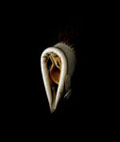
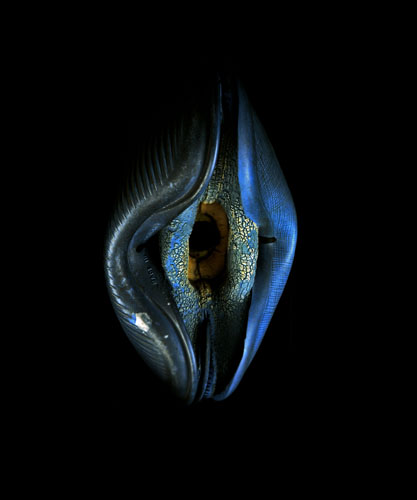
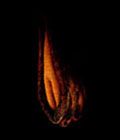
By definition the monster is incapable of reproduction: to do so would be to abandon deviation through the continuation of a genus, or genre. Invoking the law of the monster in his series Them, wherein a body is understood, but one which does not obey the rules, Treacy has nevertheless, managed to offer Them an equally deviant offspring. His most recent series, Those, is a series of what the artist calls protuberances, the parts of the body which stick out or intrude into space. Although they appear suspended in space, a ground is indicated by the way they recede slightly into blackness. They transgress genre, emerging as part human, part object, part animal.
|
|
|
|
|
|
|
|
Treacy talks of a conflation of ideas of exo- and endo-cannibalism; the former being an act of aggression against the enemy, the latter being an act of love intended to keep the spirit of the loved one alive. He talks readily of his libidinal urge to produce these images, to show off his trophies, of how without this drive there would be no point in the expenditure involved.
To point to an object which one wants, but which one cannot, or refuses to name and to say, with one�s eye as much as with one�s finger, �Those�. In language, those, when unhinged from a noun, is an empty sign awaiting an object. In Treacy�s work it is also an act of refusal: to name. Them points a different, if not entirely dissimilar, kind of finger. Treacy�s titling of each single work within the series� in the plural invokes mob. Like crowded cadavers they are mob-at-rest, yet embattled by the question of a common language, here played out in the field of naming. Through his patchworks of sloughed skins, a nameable and law-abiding thing, or body, or structure, falls into the realm of the unnameable, forcing us, behind him, to trespass and intrude into innumerable, ultimately individual boundaries. Each work speaks in an excessive, coded and unapologetically private way. As utterance, they are spoken in a profane language. If a translation were possible, it could not be reproduced here.
�Becky Beasley 2006.
(Essay commissioned by Portfolio Catalogue).
|
|
The use of a large format camera produces photographic detail in all its promiscuity, giving the clothing an excessively evidential quality which is simultaneously forensic and anthropological. Evidently the materials used are not human skins, but through a process more akin to transubstantiation than transfiguration a human fabric is invoked. For Treacy �there exists a de-construction of others by proxy (their clothing), then follows a processing of the garments so that in a way the clothing becomes my flesh.� Both series� offer a simultaneity of intimacy (acceptance) and violation (refusal).
|
|
|
|
|
|
|
Click on the map to search the regions
|