
|
Phyllis Bramson Page 1 | 2 | 3 | 4 |
||||
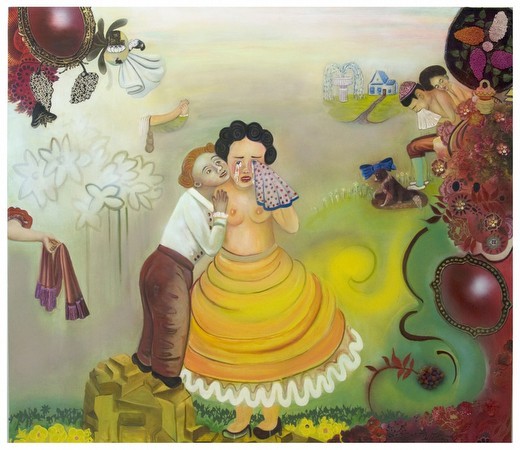
The Secret Life of People Who Care 2011 60"x70"
|
||||
|
I am perfectly comfortable with the description that my paintings project a capricious irritability and deception for I want them to be willfully fantastic and edgy. On the surface they provide a fictitious backdrop for eroticism; believing that painting still has an aura, and that it can be a repository for tenderness and occasionally originality and intoxication. For me, painting reflects the ambiguity of the every day, and therefore can be redemptive and subversive, gorgeous and disgusting – something to be celebrated and subject to suspicion as a marginalized site. |
||||
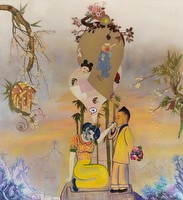
Between The Falling in Love Parts 2013 70"x60"
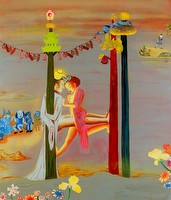
It is the mental, philosophical as well as the visual aspects surrounding painting that enlightens me. Double coded work, which uses abstracted decorative motifs fused with imagery that asks for a metaphorical rather then rational reading. Provoking and inviting speculation, my paintings are fairy-tale-like, projecting notions about ‘complicity’ and ‘good’ behavior. The paintings become phantasmagoric shifts about desire, art, culture, success, failure, faith and seduction; the work ruminates about the nature of “body trouble” and how it affects ones own existence. |
THE WALL STREET JOURNAL
September 13, 2013 Phyllis Bramson: Small Personal Dilemmas Littlejohn Contemporary Through Sept. 28 Phyllis Bramson (b. 1941) is something of a beloved artist in Chicago, whose arts community probably has the largest per-capita number of beloved artists of any city. It isn't hard to understand why. In a metropolis whose major postwar art style was everything-but-the-kitchen-sink Imagism (think Dr. Seuss on LSD), Ms. Bramson's pictures are influenced by 18th-century French Rococo art and paintings of Chinese “pleasure gardens”; they contain—to condense from the gallery's press release—conceits about life, miniaturized worlds and fairy tales, and speak about longing, innuendo and clichés. Getting all of this into paintings of moderate size is a tall order, and to accomplish that with any sort of charm—the strong point of Ms. Bramson's art—would seem even more difficult. Oddly, it's a kind of crudity—a deliberately semiclumsy combining of Western realism, Asian fog and flatness, collage and occasional glitter—that does the trick. If Ms. Bramson's paintings were any slicker, they wouldn't look as heartfelt as they do. —Mr. Plagens is an artist and writer in New York
What Is One's Real Life? 2006 72"x60" |
|||
|
||||
International contemporary art
SIGN UP FOR NEWSLETTERS
 SERVICE OVERVIEW
SIGN UP for ARTIST MEMBERSHIP
SIGN UP for GALLERY MEMBERSHIP
NEWSLETTERS & ANNOUNCEMENTS
NEWSLETTER SCHEDULE
ARTIST OPPORTUNITIES
POST ARTIST OPPORTUNITY
SERVICE OVERVIEW
SIGN UP for ARTIST MEMBERSHIP
SIGN UP for GALLERY MEMBERSHIP
NEWSLETTERS & ANNOUNCEMENTS
NEWSLETTER SCHEDULE
ARTIST OPPORTUNITIES
POST ARTIST OPPORTUNITY
Click on the map to search the directory