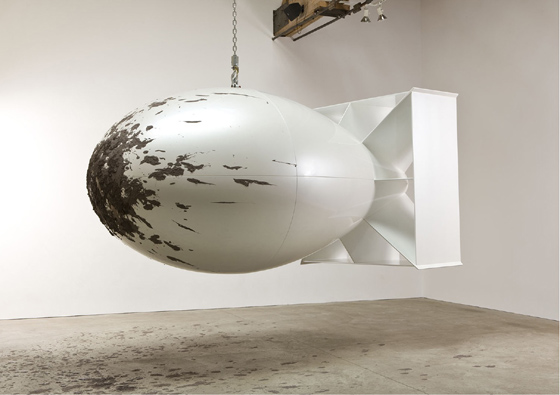
 Painted fibreglass and aluminium, sand and steel weights, chain and hoist, mud, 325×157,5×157,5cm © Iñigo Manglano-Ovalle, Courtesy: Galerie Thomas Schulte, Berlin, Donald Young Gallery, Chicago “/>
Iñigo Manglano-Ovalle, Dirty Bomb, 2008
Painted fibreglass and aluminium, sand and steel weights, chain and hoist, mud, 325×157,5×157,5cm
© Iñigo Manglano-Ovalle, Courtesy: Galerie Thomas Schulte, Berlin, Donald Young Gallery, Chicago
- Iñigo Manglano-Ovalle, Dirty Bomb, 2008
Painted fibreglass and aluminium, sand and steel weights, chain and hoist, mud, 325×157,5×157,5cm
© Iñigo Manglano-Ovalle, Courtesy: Galerie Thomas Schulte, Berlin, Donald Young Gallery, Chicago
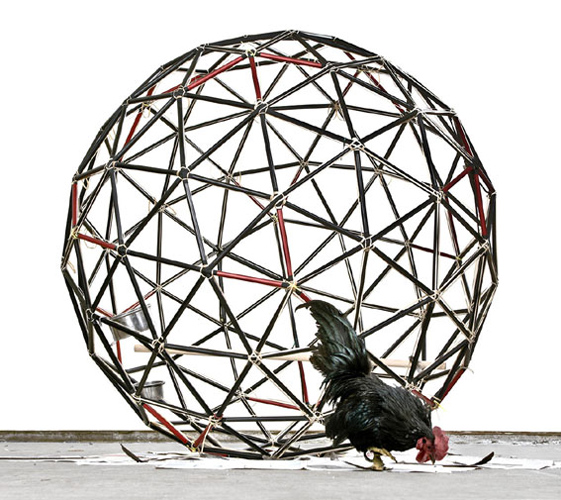
- Iñigo Manglano-Ovalle, Roost, 2008
Anondized aluminium, ABS rapid-prototyped plastic, rubberbands, newsprint, rooster feathers and drop
119 cm diameter, © Iñigo Manglano-Ovalle
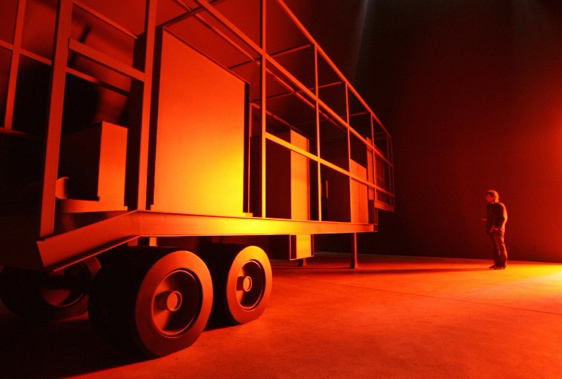
- Iñigo Manglano-Ovalle, Phantom (Truck Hidden in Kassel), Germany, 2007
Installation view at Documenta 12
© Iñigo Manglano-Ovalle
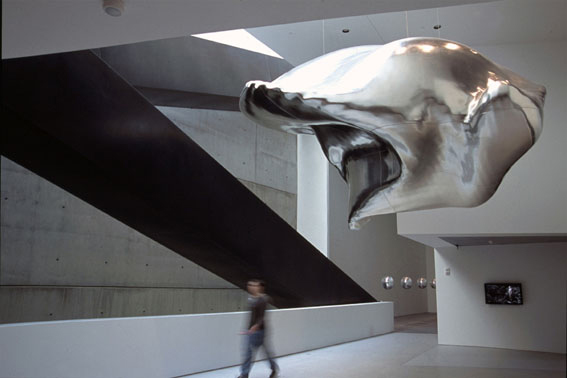
- Iñigo Manglano-Ovalle, Cloud Prototype No. 2, 2006
Installation view at The Art Institute of Chicago
© Iñigo Manglano-Ovalle
|
|
Iñigo Manglano-Ovalle, Dirty Bomb, 2008
Dirty Bomb is a full-scale reproduction of Fat Man, the second atomic bomb used in history, detonated by the United States over Nagasaki in 1945. Unlike the original, the reproduction is painted with white car varnish and splattered with mud.
Just as a sullied sports car forfeits some of its precious appearance, the bomb here almost loses its threatening aspect. A humorous reflection of the artist's strategy for the installation exhibited at Documenta XII, Phantom Truck, an accurate reproduction of the mobile laboratory for biological weapons presented in a Power Point presentation by former US Secretary of State Colin Powell before the UN Security Council as evidence of the Iraqi government's possession and production of weapons of mass destruction, Dirty Bomb now turns reality relations upside down: unlike Phantom Truck, which never really existed but was just an invention to justify the US attack of Iraq, Dirty Bomb is a copy of a weapon of mass destruction that was actually developed and used. But now, in a version that makes clear the interest of the artist in the ethical dilemma of aesthetics: “What's beautiful and what's monstrous, or are they so intertwined you can't locate either one of them? When I make a beautiful cloud, I still want people to think of a nuclear explosion.”
The Phantom Truck
a project for Documenta 12
(June 16 – September 23, 2007)
Phantom Truck is a real scale reproduction of a mobile biological weapons lab as described by U.S. Secretary of State Colin Powell when addressing the U.N. Security Council, prior to the U.S. invasion of Iraq. The sculpture is a hybrid of renderings used by Colin Powell and photographs of actual truck trailers found by Kurdish and U.S. Military forces after the invasion. The trailers found and photographed in Iraq after the U.S. invasion were later determined not to be capable of biological weapons production. Manglano-Ovalle has produced a platonic idealization of the mobile lab, giving reality to this 'phantom truck', only to conceal it again within the confines of a darkened space hidden within the exhibition.
Iñigo Manglano-Ovalle
Iñigo Manglano-Ovalle was born in 1961, in Madrid, Spain, and currently lives and works in Chicago, Illinois. He received B.A. degrees in Art and Art History as well as Latin American and Spanish literature from Williams College in Williamstown, Massachusetts in 1983. In 1989, he completed his M.F.A. degree in sculpture from The School of The Art Institute of Chicago. Manglano-Ovalle investigates diverse subjects such as technology, climate, immigration and the global impact of social, political, environmental, and scientific systems. Often working in partnership or employing technical experts across multiple disciplines including engineering, architecture, genomics, and climatology, Manglano-Ovalle produces objects that are often technically complex, formally captivating, and conceptually engaging. His early work focused on collaborative explorations with young people in his hometown of Chicago, which led to the founding of Street-Level Youth Media, a community arts organization for youth in 1993. Across multiple independent projects executed during the same period, Manglano-Ovalle explored a multi-faceted and socially-focused approach to art making, blending layered concepts with a variety of materials both typical and unorthodox. Incorporating objects such as identification cards in Assigned Identities (1991) or automobile tires in Flotilla (1991), Manglano-Ovalle made reference to the difficulties surrounding illegal immigration into the United States. In the sculptural works Bloom (1995–96) and Subwoofer (1995), Manglano-Ovalle utilized ballistic gelatin, firearms and car sound systems to explore notions of violence and division. His noted film trilogy Le Baiser/The Kiss (1999), Climate (2000), and In Ordinary Time (2001) focused on the architecture of Mies van der Rohe and the implications of Modernism. More recently, he has employed genomic and meteorological methodologies to explore issues of race, identity, and the promise and threat of technology in works such as Cloud Prototype No. 1 (2003) and Portrait of a Young Reader (2006).
Manglano-Ovalle has exhibited his work at acclaimed institutions both nationally and internationally. Selected one-person exhibitions include Focus: Iñigo Manglano-Ovalle, The Art Institute of Chicago (2005), The Krefeld Suite, Museum Haus Esters and Haus Lange, Krefend, Germany (2005), Iñigo Manglano-Ovalle, El Museo de Arte Contemporáneo de Monterrey and Museo Tamayo Arte
Contemporaneo, Mexico City (2004), Iñigo Manglano-Ovalle, Sala de Exposiciones de la Fundación “la Caixa”, Madrid, Spain (2003), White Flags, Barcelona Pavilion, Fundación Mies van der Rohe, Barcelona, Spain (2002), and Balsero, Museum of Contemporary Art, Chicago (1997), among many others. Group exhibitions include the Liverpool Biennial (2004 and 2006), Moving Pictures, Solomon R. Guggenheim Museum, New York and Guggenheim Museum, Bilbao, Spain (2002 and 2003), Tempo, Museum of Modern Art, New York (2002), Bienal de São Paulo, São Paulo, Brazil (1998), and the Whitney Biennial, Whitney Museum of American Art, New York (2000). He has received the John D. and Catherine T. MacArthur Foundation fellowship (2001), the Media Arts Award from the Wexner Center for the Arts (1997), and a National Endowment for the Arts fellowship (1995).
|
Iñigo Manglano-Ovalle
Chicago, IL
Illinois
North America
T:
F:
M:
|
|
Web Links
Iñigo Manglano-Ovalle
Galerie Thomas Schulte, Berlin
Donald Young Gallery, Chicago
Max Protetch, New York
Galeria Soledad Lorenzo, Madrid
|
|

 SERVICE OVERVIEW
SIGN UP for ARTIST MEMBERSHIP
SIGN UP for GALLERY MEMBERSHIP
NEWSLETTERS & ANNOUNCEMENTS
NEWSLETTER SCHEDULE
ARTIST OPPORTUNITIES
POST ARTIST OPPORTUNITY
SERVICE OVERVIEW
SIGN UP for ARTIST MEMBERSHIP
SIGN UP for GALLERY MEMBERSHIP
NEWSLETTERS & ANNOUNCEMENTS
NEWSLETTER SCHEDULE
ARTIST OPPORTUNITIES
POST ARTIST OPPORTUNITY