
|
David Palacios Page 1 |
|||||||||
|
|||||||||
|
The increased use of bricks, preferably exposed, is not limited to the material aspect, but is also includes the symbolic dimension. Transcending its use-value, there is an infinite number of meanings in the presence of one brick, or a group of bricks, in a work of art. Ironically, the use and abuse of one referent to suggest diverse meanings has become one of the many common threads in art today.
|
|
|||||||
|
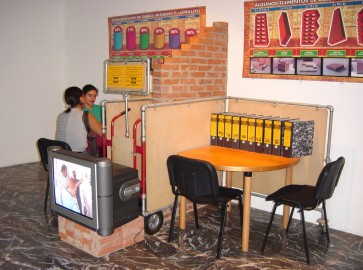
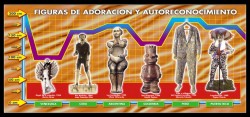
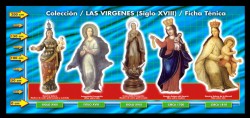
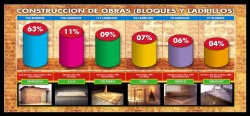
When a material or an artistic technique, in this case brick, is used repetitively it becomes banal, it loses its aura as it gets closer to the anonymous world of industrial production. – Taking this into consideration, Palacios’ exhibit is centered on the strategy of mediation, with the first stage detailing the inventory of those works and authors that compose what could be considered a ‘poetics of brick.’ Palacios distributed this material among the workers of a brick factory, Obra Limpia, located in Guatire, a few miles from Caracas. Each one of the workers in this factory, the majority of them a high school education, received a personalized folder with the images in question so they could see and become familiar with what is done in the art world with the very bricks that they produce in the factory. Some of these images were also displayed on a wheelbarrow mural built on site with tubes and plates of artificial wood. During the process Palacios documented the stages of the experience and requested information about the typology and function of bricks as well as how they are produced. The documentation of this itinerary inside the plant is part of the exhibition, which is set up like a large video installation combining photographic and audiovisual documents, statistical graphics, and
|
|||||||||
|
folders placed on movable shelves designed by the Palacios. ….. As in other works by Palacios, this project is situated between irony and parody. . ….. This notion becomes even more suggestive in so far as the exhibition adopts the model of a study, subject to bureaucratic and falsely systematic classification, turning the work into the parody of an archive. Added to these are references
|
|
to popular engineering, specially those structures built by street peddlers for the display of their merchandise, the model Palacios uses for the construction of his mural wheelbarow and his shelves. This interplay of audiovisual technology and popular solutions produces a kind of eclectic atmosphere. Based on the union of heterogeneous elements, ‘Zona de distension…’ is grounded in an experience of symbolic exchange that transcends disciplinary fragmentation and promotes the collaboration between distinct forms of human activity. Author: Felix Suazo
|
|||||||
|
|||||||||
International contemporary art

SIGN UP FOR NEWSLETTERS
 SERVICE OVERVIEW
SIGN UP for ARTIST MEMBERSHIP
SIGN UP for GALLERY MEMBERSHIP
NEWSLETTERS & ANNOUNCEMENTS
NEWSLETTER SCHEDULE
ARTIST OPPORTUNITIES
POST ARTIST OPPORTUNITY
SERVICE OVERVIEW
SIGN UP for ARTIST MEMBERSHIP
SIGN UP for GALLERY MEMBERSHIP
NEWSLETTERS & ANNOUNCEMENTS
NEWSLETTER SCHEDULE
ARTIST OPPORTUNITIES
POST ARTIST OPPORTUNITY
Click on the map to search the directory