
|
Brenda Garand Page 1 |
|||||||||
|
|||||||||
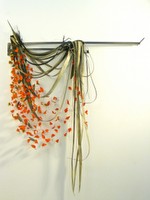
"Manitou"
|
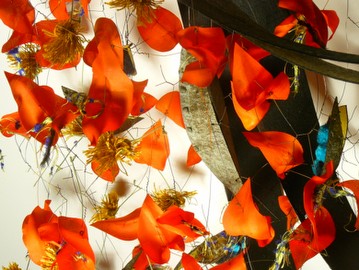
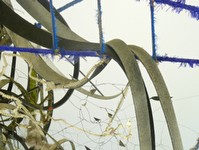
“Garand's notions of nature and culture evoke her French-Canadian, Abenaki, and British heritages. She employs materials associated with construction, hunting and fishing-including roofing paper, wire, and steel, fish hooks and lures, and porcupine quills-and reinforces those allusions through her titles.”
Jan Garden Castro Sculpture Magazine New York Review June 2015 |
|
|||||||
|
“From the mid-1980s, when she began exhibiting in New York, Brenda Garand has continued investigating the language of abstraction and its potentials for meaning. Now spanning three decades, her art is distinguished by a decided emphasis on visual values that has grown even more intense and compelling in the wall sculptures and gouache and ink drawings produced since 2001. The strong visual aspects of her work are the product of a creative process at the crux of which is a passion for engagement with real-world subjects. The subjects that move her are invariably those carrying deep resonances. They come from the personal sphere encompassing autobiography,family traditions, and heritage. Key to her aesthetic and underscoring her approach is a need and desire to search out and express connections, dualities, and contrasts. Her awareness of these important factors in her work starts quite early.
“A World About: Brenda Garand's Recent Sculptures and Drawings” By Ronny Cohen |
|||||||||
|
“On the subject of the new work, the artist is understandably silent. This is very much a series in progress, and there are further Canadian explorations underway. We can only watchfully wait to see what forms and ideas emerge from the northern latitudes.
“Brenda Garand” Bill Barrette |
"Manitoulin"
|
“That is the key to why we take pleasure in works such as Garand's that juxtapose contrasting materials. We are continually faced in life with conflicts, between freedom and responsibility, between competing affections, between the prosaic and the poetic. It is deep in our nature that we seek resolution of those conflicts. Resolution of conflict is a fundamental driver of evolution, both in our own lives and in our species.”
Philip F. Palmedo The Experience of Modern Sculpture: A Guide to Enjoying Works of the Past 100 Years |
|||||||
|
|||||||||
International contemporary art
SIGN UP FOR NEWSLETTERS
 SERVICE OVERVIEW
SIGN UP for ARTIST MEMBERSHIP
SIGN UP for GALLERY MEMBERSHIP
NEWSLETTERS & ANNOUNCEMENTS
NEWSLETTER SCHEDULE
ARTIST OPPORTUNITIES
POST ARTIST OPPORTUNITY
SERVICE OVERVIEW
SIGN UP for ARTIST MEMBERSHIP
SIGN UP for GALLERY MEMBERSHIP
NEWSLETTERS & ANNOUNCEMENTS
NEWSLETTER SCHEDULE
ARTIST OPPORTUNITIES
POST ARTIST OPPORTUNITY
Click on the map to search the directory