|
MAPPING THE ABSTRACT
BENJAMIN BRETT | BLAKE DANIELS | ROBERT
FRY
9 August
– 21 September, 2013
Private
View: 8 August 6-9pm
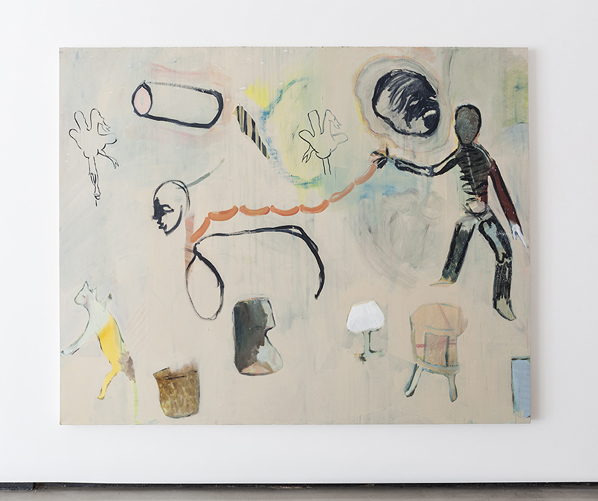
Benjamin Brett, 'Untitled' (2013),
oil on linen, 188x235cm
Mapping the Abstract presents three
artists who approach abstract painting with a remarkably fresh
perspective. While today the idea of The Abstract
typically provokes notions technology and digital media, each
Benjamin Brett, Blake Daniels, and Robert Fry consider
abstraction as an organic and gestural process – proving that
perhaps painting – one of the most conventional of
disciplines – ultimately triumphs as perhaps the most
experimental, exhilarating, and enduring of all
media.
Upon
first instance the works might each appear to be departures
from a school of figuration, however, while this may provide a
type of initial segue between the artists, one notices the
deepest correlation (or even more markedly, the strongest
difference,) lies in each artist’s relationship to space:
precisely, how paint maps the confines of an understanding of
space as transcribed within the two-dimensionality of the
canvas. Here, the concept of abstraction involves complexities
deeper than geometry or merely disjointed figuration. More
telling still is how any narrative that seems to unfold within
the work is verified and negated in equal measure through its
own very presence; these are painterly constructions operating
like an Ouroboros – a symbol from Ancient Egypt of a snake
which consumes its own tail, suggesting a self-fulfilling
prophecy, one which Jungian psychology later appropriated to
suggest the realm of possibility of the human psyche. Somehow,
this carnal, metaphorical beast seems strangely appropriate as
a metaphor for the psychological realms mapped
here.
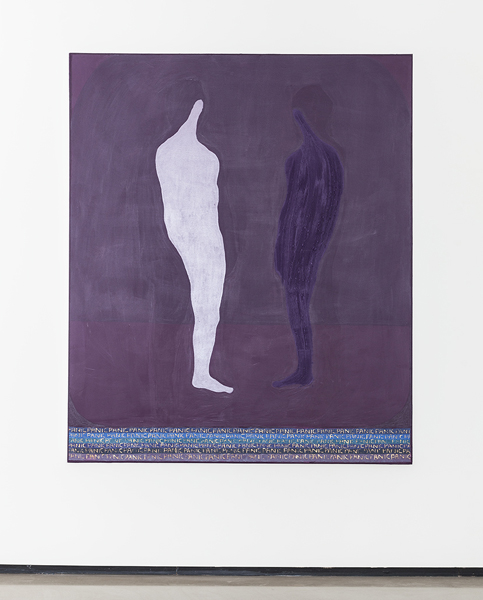 Robert Fry, 'Related Study
E', (2011), oil, acrylic, and mixed media on canvas,
175x145cm
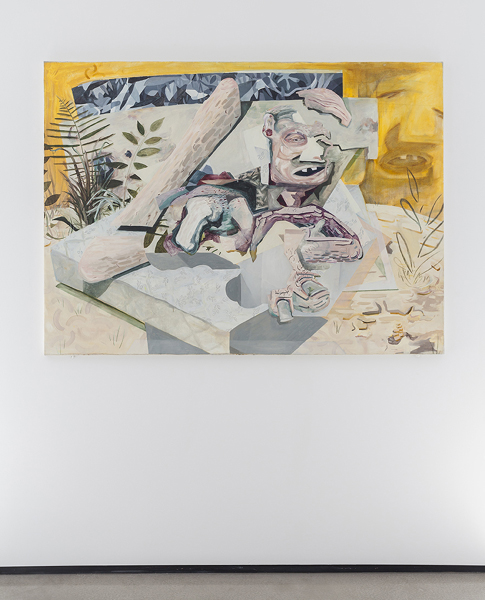
Perhaps
the beings in Blake Daniels’ works come across as the most
overtly humanoid and narrative based, yet his paintings are
concerned with what is happening on a much more complex scale
in which he is omniscient creator of his own diegesis. His
works depict bodies and spaces that have been dislocated and
fragmented through the externalization of imagined space. But
is narrative of any importance here at all? Certainly any
linear-narrative takes a secondary role to the relationship
that occurs tangentially: their textural quality, their daring
and off-kilter compositions, the abundance of oblong shapes
that might suggest limbs, tongues, plants, animals, or
viscera, or conversely, that may exist within the
confines of the painting just because.
Similarly, Myriam Blundell writes that Robert Fry’s
"enduring preoccupation is to find a visual equivalent to the
metaphysical space separating the act of representation from
the language of abstraction". While the suggestion of the
figure is central to Fry’s practice, it is the relationship
between the being, the surrounding, and the paint itself
wherein which Fry finds his locus. Here we are most drawn into
his mark-making, the atypical color-choices and painterly
confidence that affirm Fry’s world. The omnipresence of
variations on a deep purple color (while un-gendered, is
historically linked to royalty and piety) becomes Fry’s
trademark of-sorts, where shadows, anatomical extensions, and
dismembered body parts strangely summon thoughts of deepened
psychological states, not unlike Rorschach inkblots. But
something about his color choice becomes undeniably carnal –
references to Bacon, Guston, Twombly, (and, in Man with
Vesalius Skeleton, even Dutch anatomist Andreas Vesalius)
– but the languages and landscapes emerge as undoubtedly Fry’s
own creation.
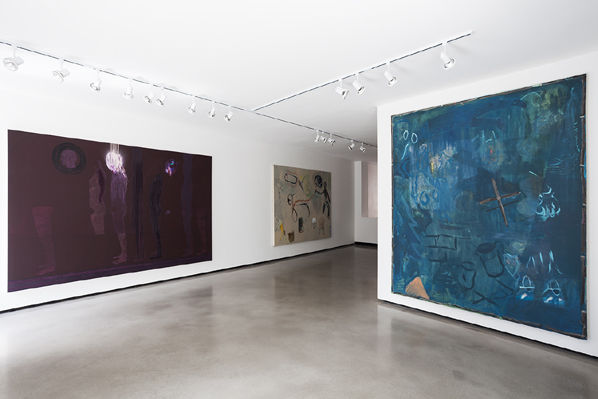 'Mapping
the Abstract' installation view
The
works that enunciate the least diegesis here may also perhaps
the most narrative-driven; Benjamin Brett takes an almost
playful approach to the concept of space, where a defining
sense of context prevails in lieu of seemingly little subject
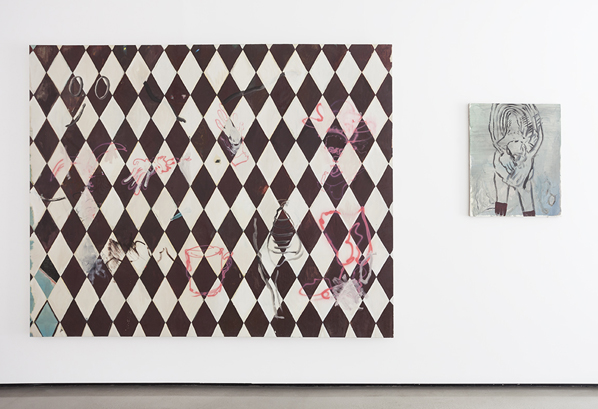
matter. Yet we are scarce to see any regimented approaches
here, apart from the occasional rhombus-motif foundation lain
beneath which his painterly gesture takes shape, where
whimsical gestures and references emerge as buoyant,
suggestive, and barely figurative, almost Matisse-like. Yet
the mind connects these painterly marks into a kind of mental
connect-the-dots, where narratives inevitably emerge.
But it cannot be precisely said whether Brett’s intentions are
to have the viewer construct narrative, or we are simply
hard-wired to consider symbols in this semiological
manner?
All
three artists have created a subtle tapestry for our
consideration, wherein confident but marginally-obscure colour
choices and sublimated, subtle figurative articulations trace
the stream-of-consciousness markings of the maker, and
palimpsestial colours beneath layers and layers of paint
suggest paintings beneath paintings – a process of definition
and re-definition: redefining, obscuring, marking and mapping
the abstract.
Benjamin Brett, 'Untitled' (2013),
oil on linen, 188x235cm (left), ‘Dancer’ (2013), oil on linen,
70x40cm
ROBERT FRY (b. 1980, London) has exhibited at
galleries and institutions in the UK and abroad. He has had
solo exhibitions at Alexia Goethe Gallery, London (2009),
Atelier 2, Moscow (2009) and M and B Gallery, Los Angeles
(2010). Selected group shows include, Newspeak
Saatchi Gallery, London and the State Hermitage Muesuem, St
Petersburg (2011), On the Horizon, Marine
Contempoary, Los Angeles (2012), Man, Myth and the
Machine, Erika Deak Gallery, Budapest, Hungary (2011),
Deep Space, Francois Ghebaly Gallery, Los Angeles,
USA (2012) and the Summer Exhibition, Royal Academy
London (2011). Fry has previously been shortlisted for
the John Moores Prize. Upcoming shows include a solo
exhibition with Gallery Kornfeld, Berlin in September 2013.
Fry’s work is included in various collections including
Saatchi, Mario Testino, Museum of Modern Art Moscow and
private collections throughout Europe, South Korea and
USA. He frequently donates to charitable associations,
including the annual MacMillan Art Auction in aid of MacMillan
Cancer Support.
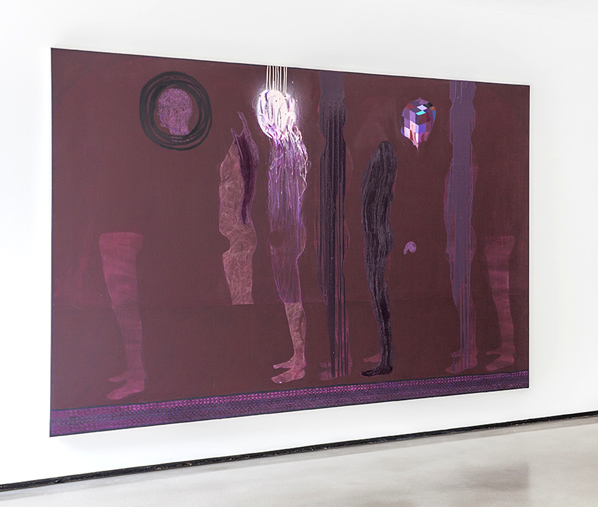 Robert Fry, 'Red
15' (2013), oil, acrylic, and mixed media on canvas,
198x285cm
BLAKE
DANIELS (b. 1990, United States) is a recipient of the Edward
L. Ryerson Fellowship from the School of the Art Institute of
Chicago, has worked and exhibited across the United States,
South Africa, Jamaica, Trinidad and Tobago, Canada and the
United Kingdom. His large-scale paintings map abstraction
directly onto figure and space, demanding a reinterpretation
of how painting functions within the conditions of the twenty
first century. Recent and forthcoming exhibitions include
New Work, Sullivan Gallery, Chicago, Illinois
(January 2013); the Free City International Arts
Festival, Chevy-in-the-Hole Gallery, Flint, Michigan (May
2013); That Ship Has Sailed, Edna Manley College of
Visual and Performing Arts, Kingston, Jamaica (October 2013);
amongst Daniels participation in the Rex Nettleford Arts
Conference with the Edna Manley College of Visual and
Performing Arts in Kingston, Jamaica and the Meeting Place:
Caribbean InTransit Symposium with the University of the West
Indies in St. Augustine, Trinidad and Tobago.
BENJAMIN BRETT (b. 1982, Norwich) holds an MA in
Painting from the Royal College of Art, London where e piece
was acquired for the prestigious RCA Collection at his recent
RCA Degree Show in June. Selected group exhibitions include
Satelike at the Departure Foundation in Canary Wharf
(2013); Blyth Gallery, Imperial College, London, (2013);
Royal College of Art Summer Show (2012); Real
Phony, Norwich (2010); Liminal, OUTPOST Gallery,
Norwich (2010); Royal Academy Summer Exhibitions,
Burlington Gardens, London (2010); Hive Projects
(T1+2 Gallery), Selected Group show, Whitechapel, London and
All Capital Letters T1+2 in collaboration with
Deutsche Bank, London (2010).
Blake Daniels, 'Ag Pleez Deddy'
(2012), oil on canvas, 110x152cm
BEERS.LAMBERT
contemporary
1
Baldwin Street
London,
EC1V 9NU
Tel.
+44(0)207 502 9078
info @
beerslambert.com
www.beerslambert.com
|