
|
Postmasters Gallery presents KRISTIN LUCAS & JOE McKAY | GIOVANNI GARCIA-FENECH Archive | Information & News |
||||
|
KRISTIN LUCAS and JOE McKAY
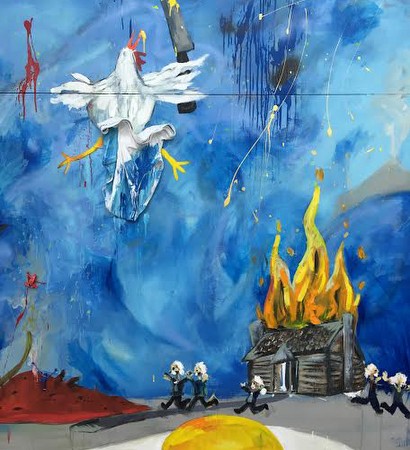
Away From Keyboard December 11, 2015 – January 23, 2016 December 11, 2015 – January 23, 2016 “/>acrylic on canvas, 60 x 60 inches; “/> |
|||
|
||||
|
KRISTIN LUCAS and JOE McKAY Away From Keyboard [Intro] Postmasters is pleased to present an exhibition of new works by Kristin Lucas and Joe McKay that playfully redirect the user experience away from everyday prescriptive movements. Lucas investigates the uncanny and disorienting influence of digital technologies as they disrupt traditional notions of self, order and place. McKay makes games with alternative interfaces that call to question our interactions with ubiquitous technologies. The show will include individual works of each artist as well as a group of interactive sculptures, Tablet Tumblers. Tablet Tumblers are made collaboratively by Lucas and McKay under the collective name Electric Donut. [Exhibition synopsis] 1. Kristin Lucas: A. Sole Soaker is an interactive virtual environment that features a “pedestrian roller coaster” – a fictional roller coaster-like structure composed entirely of steps. Viewers can experience a first-person perspective of this enormous, fictional 'ride', using a game controller to climb and descend its stairways as the sea level gradually rises and falls around them. B. Inventory features a vending cart covered in 3d printed goods. C. Sick Waves video is a mesmerizing telescoped whirl of waves that may produce a sensation of unease. 2. Joe McKay: A. OmegaMouse is a computer game for one to six players. Players engage upon a wobbly plane that spins on a 3d axis as players leave and enter the play field. 3. Electric Donut: A. Tablet Tumbler: Flat Roller An object outfitted with mobile computing tablets functions as a multiple-camera recording device utilizing the tablets’ built-in cameras. Recordings are presented as a continuous six-channel rolling point of view video that jump cuts through New York City-area living spaces. Participants navigate the tumbler through their own spaces and are given latitude for personal expression. Unlike traditional mapping services, the tumbler records its surroundings through a method of chance operation. “Flat Roller” takes no stock in logical pathways, practical outcomes, or completeness. B. Tablet Tumbler: Martian Sol Cycle Visualizes a full day of the sky as seen from Mars. The view rotates on Martian time. C. Tablet Tumbler: PlusPlus is ecstatic about increments. The title “PlusPlus” is derived from programming languages. The operator “++” is used to represent a variable’s increase in value. D. Tablet Tumbler: Upscale Scribble Interaction draws a red line on Google Maps. Small movements produce larger than life scribbles. Plays with impact scale. [Food for thought] The design of the Tablet Tumbler object has many human‐engineered technological references, including the wheel which allowed for mechanized systems, the cable drum which is used to lay communication wires across land and sea, and the Google Street View car. Cyclical and cinematic references include the pre‐cinema zoetrope, film loop, animated GIF, and programmed computer routine. Considering that interaction with the object requires human will and physical power, there is a playful connection to the story of Sisyphus who is compelled to push a rock up a hill over and again. There is also a mythical connection to the recent Japanese video game Katamari Damacy in which users participate in a narrative by pushing a magical adhesive ball around the city and its surroundings, collecting increasingly larger objects from thumb tacks to people to airplanes to mountains until it the ball is large enough to form a star. From yet another point of view in our fast‐changing world of technological innovation, the Tablet Tumbler object can be seen as tumbleweed of aging technology. [Credits] The Tablet Tumbler series was produced with the support of Eyebeam, Foundation for Contemporary Arts (FCA), SUNY Purchase College, and The University of Texas at Austin College of Fine Arts. — GIOVANNI GARCIA-FENECH New Paintings I wanted to make work that communicated something personal rather than intellectual, something that wouldn't protect me from embarrassment or rejection—so I decided to start painting myself. Not how I looked, but how I felt about myself and my body. – Giovanni Garcia-Fenech Giovanni Garcia-Fenech's first solo exhibition at Postmasters features a selection of the artist's most recent revealing self-portraits, the unflinching focus on himself leavened with a healthy dose of self-deprecating humor. Six of the paintings present the artist’s naked body awkwardly crammed into L-shaped canvases that simultaneously bring to mind the tortured figures of medieval crucifixions and the shaped paintings of formalists like Frank Stella and Kenneth Noland. Other works depict the artist writhing between two circles—”two problems,” as he calls them—in which these shapes can be read as symbolic black orbs of ominous foreboding or, more literally, formal problems. I improvise without the aid of a mirror. That makes me rely on how I perceive myself, rather than copying what I see. It also keeps me from over-thinking the work, and it forces me to remain engaged with the painting from beginning to end. The unpolished results add another layer of candor: what you see is the best I could do at the time that I did it. Garcia-Fenech's works are one-shot improvisations, painted directly on the canvas without preliminary sketches. His work takes inspiration from a wide variety of sources, including tribal art, Byzantine icons, outsider art, illuminated manuscripts, German Expressionism, hard-edge and colorfield abstraction, and '80s figurative painting. The results encompass a number of contradictions: a combination of grace and awkwardness, of realism and distortion, and of narcissism and embarrassment. Giovanni Garcia-Fenech lives and works in New York City. He received an MFA from the School of Visual Arts and BA's in psychology and art from Austin College. His artwork has been exhibited throughout the United States, as well as in Iceland and the Netherlands. —- Postmasters Gallery located at 54 Franklin Street in Tribeca Tuesday through Saturday 11 – 6 pm with Thursday hours extended to 8pm Please contact Magdalena Sawon or Paulina Bebecka with questions and image requests [email protected] www.postmastersart.com |
||||
|
||||
International contemporary art
SIGN UP FOR NEWSLETTERS
 SERVICE OVERVIEW
SIGN UP for ARTIST MEMBERSHIP
SIGN UP for GALLERY MEMBERSHIP
NEWSLETTERS & ANNOUNCEMENTS
NEWSLETTER SCHEDULE
ARTIST OPPORTUNITIES
POST ARTIST OPPORTUNITY
SERVICE OVERVIEW
SIGN UP for ARTIST MEMBERSHIP
SIGN UP for GALLERY MEMBERSHIP
NEWSLETTERS & ANNOUNCEMENTS
NEWSLETTER SCHEDULE
ARTIST OPPORTUNITIES
POST ARTIST OPPORTUNITY
Click on the map to search the directory